














 Email
Email SMS
SMS Whatsapp
 Web Push
 App Push
 Audience Sync for Ads
 Popups
 Channel A/B Testing
  Control groups Analysis
 Frequency Capping
 Funnel Analysis
 Cohort Analysis
 RFM Analysis
 Signup Forms
 Surveys
 NPS
NPS Landing pages personalization
  Website A/B Testing
  PWA/TWA
 Heatmaps
 Session Recording
 Wix
Wix Shopify
 Magento
 Woocommerce
 eCommerce D2C
  Mutual Funds
 Insurance
 Lending
  Recipes
  Knowledgebase
 Developer Docs
 Product Updates
 App Marketplace
 Academy
 Ebooks
 Case Studies
 Blog
Blog Templates
 Aparupa Saha
You know what’s funny? Brands will spend thousands getting someone to buy. Ads, retargeting, influencer deals, SEO, the whole machine running at full capacity. Customer finally converts. And then what? A receipt email. Maybe a “how’s your order” follow-up if someone remembered to set it up. That’s it.
The customer just made a purchase decision, probably a little excited, maybe a little uncertain, and the brand essentially vanishes. No real guidance. No acknowledgement that this person matters now. Just silence and a tracking number.
Intelligent Journeys for Post-Purchase exist to fix this. And no, this is not just a fancy name for a drip sequence. A drip sends the same emails to everyone on the same schedule, regardless of what any individual customer actually does. Intelligent journeys respond. Does the customer visit the returns page three days after delivery? The journey catches that. Customer opens every onboarding email and comes back to the site twice in one week? Caught that too, and the response is completely different.
Real-time behavioural data driving what happens next. That is the core of it.
NVECTA is built for exactly this kind of engagement. It is an AI-powered customer data platform and engagement platform that pulls customer data together across every channel and runs personalised, automated journeys that keep buyers active long after checkout. The post-purchase phase stops being an afterthought and starts being one of the most productive parts of the customer lifecycle.
What “Intelligent Journeys for Post-Purchase” Actually Means in Practice
The term gets abused. So let’s just be direct about what it means and what it doesn’t.
It does not mean a longer drip sequence. It does not mean adding SMS to your email flow. It does not mean segmenting by purchase value and sending slightly different subject lines.
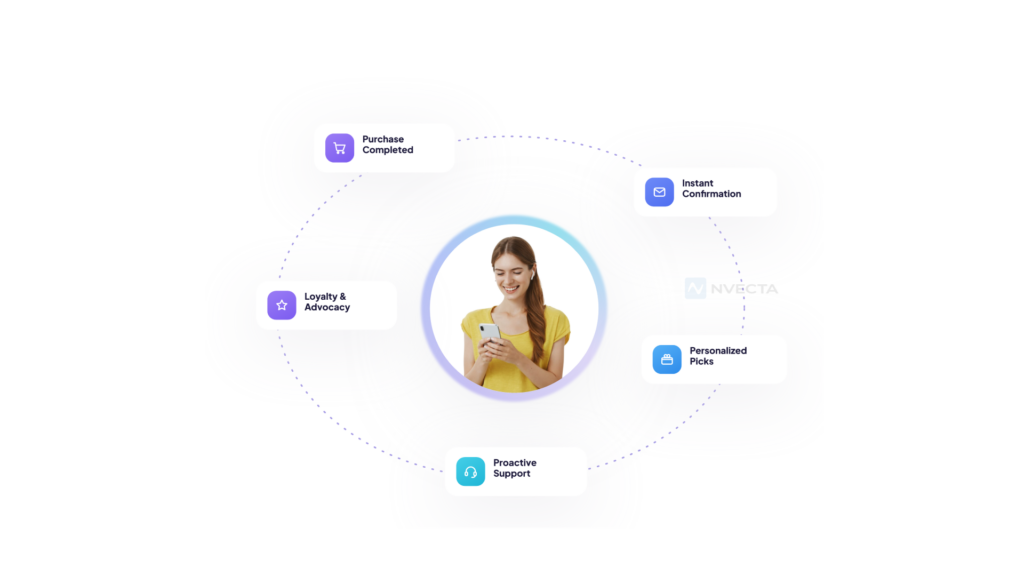
Here’s what it actually means. The system watches what each customer does after they buy. Every action, or lack of action, is a signal. And the journey responds to those signals in real time rather than following a script written before the customer ever showed up.
Someone who buys and then spends 15 minutes on your FAQ page within 48 hours? That’s friction. Something is confusing them. A good intelligent journey routes a helpful support touchpoint right there, before that friction turns into a return or a bad review.
Someone who buys, opens every email, clicks through to browse related products, and posts about the purchase on social? That person is not in the same place as the confused FAQ browser. The journey should be treating them completely differently. They are already leaning toward advocacy. Push them there.
Someone who bought and has not opened a single thing in two weeks? Different channel, different angle, maybe a longer pause before hitting them again.
The point is that the journey reads the actual human behaviour and adapts. Not on a schedule. Not based on assumptions. Based on what is actually happening.
Why Brands Keep Underfunding This Phase
Honest answer? Post-purchase results do not appear quickly enough.
Acquisition metrics are immediate. Cost per click, ROAS, and conversion rate, you can see them update in real time. Post-purchase impact, repeat purchases, lifetime value, referral revenue, that takes months to build, and it doesn’t tie cleanly to any single campaign spend. So when the budget conversation comes around, it gets squeezed. Every time.
And then brands wonder why their retention numbers are weak.
Here is the math, though. Repeat customers consistently spend more per transaction than first-time buyers. Improving retention by even a small percentage generates profit gains that would require a massive increase in acquisition spend to match.
And customers who feel genuinely cared for after a purchase, not just targeted for the next one, have a lifetime value that dwarfs that of passive one-time buyers.
The post-purchase window is also just a really good moment to engage someone. They made a decision. They are paying attention to your brand in a way they probably will not be again unless you earn it back.
That window is maybe 48 to 72 hours wide. Brands that show up with something relevant inside that window are working with the moment. Brands that wait a week are already playing catch-up.
The Five Stages and What Actually Happens at Each One
Stage 1: The First 48 Hours
The confirmation email is not a receipt. It is an opening move.
What most brands do with it: send order details and a tracking link. Fine. But that is the floor, not the ceiling.
What an intelligent journey does: uses what it already knows about this customer to shape the first few touchpoints. Is this their first purchase or their fifth? Was it a high-value order or a small trial?
Did they come in through a referral or a paid ad? Each of those contexts produces a different kind of post-purchase experience. The platform reads it automatically and routes accordingly.
First-time buyer gets a guided welcome. A returning customer gets something that acknowledges the relationship. High-value orders get white-glove onboarding. The system decides. Not a human manually tagging segments.
Stage 2: Adoption and Engagement
This is the stage most brands skip. And honestly, it is where a lot of churn gets quietly seeded.
A customer who buys something and never really gets value from it won’t come back. They might not even leave a negative review. They will just disappear. And the brand will assume it was a targeting or product problem when it was actually a post-purchase one.
Intelligent journeys monitor engagement signals after delivery. Someone who looks like they are getting value, opening emails, using the product, returning to the site, gets content that deepens that.
Someone who looks stuck or disengaged gets a proactive nudge. A tip. A check-in. Something that meets them where they are, before frustration becomes a decision.
Stage 3: Asking for Feedback
Timing a feedback request is genuinely tricky, and most brands just pick an arbitrary day and stick with it.
Day seven. Day fourteen. Whatever felt right when someone set it up. Same for everyone.
The problem is that day seven for one customer and day seven for another are completely different situations. One person has used the product every day and loves it. Another person just opened the box yesterday. Sending them the same review request at the same time makes no sense.
An intelligent journey identifies the right moment for each customer based on their behaviour. The highly engaged customer gets asked sooner.
The quieter one gets more time. And when a positive score comes back, the journey does not just log it and move on. That is the entry point for something bigger. Referral ask, loyalty invite, early access offer. The satisfied customer is most reachable right after they tell you they are satisfied. Use that.
Stage 4: Re-engagement
Customers drift. Even the happy ones. Life happens, attention moves, and three months later, someone who genuinely liked your brand just hasn’t thought about you in a while. The brands that get those customers back are the ones that caught the drift early.
Early warning signals exist. Drop in email opens. Fewer site visits. No repeat purchase activity after a certain window. An intelligent journey tracks those signals and triggers re-engagement before the customer has made any conscious decision to leave. That timing is everything.
A message that arrives when someone is starting to drift converts at a completely different rate than a win-back email sent six months after they’ve already moved on.
And the message itself matters. Not a generic “we miss you” with a discount code. Something specific. Something that references what they actually bought, what they actually engaged with. Something that makes them feel remembered, not marketed to.
Stage 5: Advocacy
This is where everything compounds.
A customer who refers someone is not just a revenue source. They are a trust transfer. Word of mouth from a real customer carries weight that no ad ever will. But referral programs fail constantly because brands treat every customer as a potential referrer.
Not everyone is. Sending a referral program invitation to your whole list mostly generates noise. A few conversions, a lot of unsubscribes, and a general sense that you care more about growth than about the relationship.
Intelligent journeys identify the customers who are actually enthusiastic. High purchase frequency, strong engagement, positive feedback, and organic social behaviour.
When those signals line up, the advocacy program activates for that specific person at the right moment. That targeting precision is the difference between a referral program that works and one that exists on paper.
What the Infrastructure Needs to Look Like
| Component | What It Does | What Breaks Without It |
| Customer Data Platform | Builds unified real-time profiles across all channels and touchpoints | Journey logic runs on incomplete data and produces wrong interactions at the wrong moments |
| Behavioral Triggers | Fire actions based on actual customer behaviour, not preset schedules | Messages go out on timelines instead of signals and lose relevance fast |
| Predictive AI Scoring | Continuously scores customers on churn risk, advocacy readiness, and upsell potential | Static segments create blind spots and missed moments throughout the journey |
| Multichannel Orchestration | Runs email, SMS, push, in-app, and retargeting as one coordinated system | Customers get contradictory or redundant messages across channels |
| Continuous Optimization | Feeds performance data back into journey logic to improve over time | Performance plateaus and eventually degrades without feedback loops |
The Metrics That Actually Tell You If It’s Working
Open rates are not the answer here. Neither is click-through rate on its own. The metrics that matter are the ones tied to actual relationship progression.
Repeat purchase rate within 90 days: The most direct indicator of whether the post-purchase journey is serving a useful purpose. A low number here almost always means a broken onboarding or engagement stage.
Time to second purchase: How fast does a first-time buyer become a returning one? Shortening this window even slightly has a serious revenue impact at scale.
First-purchase churn rate: One-and-done buyers are nearly always a post-purchase failure. A high number here signals that customers are not being given a reason to return.
NPS: Not a perfect metric, but a reliable proxy for who is advocacy-ready and who needs recovery attention.
Referral conversion rate: Are the people entering your referral program actually converting? A low rate usually means the ask is reaching the wrong customers.
Customer lifetime value: The long view. Intelligent journeys should push this number up over time. Flat or declining CLV means the journey is not building compounding relationships.
The Mistakes That Quietly Kill Post-Purchase Performance
Treating a seven-time buyer the same as someone who just purchased for the first time. Happens constantly. Someone who has been a customer for two years getting a welcome series is just bad data hygiene dressed up as automation.
Sending volume instead of relevance. More emails to everyone equally is not a retention strategy. The brands that calibrate frequency to individual engagement levels, more to active customers, less to quiet ones, consistently outperform the ones blasting their whole list.
Ignoring negative signals mid-journey. A support ticket filed three days after delivery should change what happens next. If the journey does not read that signal and adjust, that customer is getting a review request while they are actively frustrated. A recoverable situation made worse by bad timing.
Asking for referrals before earning them. Advocacy activation works when it follows demonstrated satisfaction. Brands that ask too early, before the customer has had time to form a real opinion, get poor conversion and sometimes resentment.
How NVECTA Makes This Work at Scale
Running intelligent journeys across thousands of customers simultaneously is not something a standard email tool handles. You need unified data, predictive scoring, multichannel orchestration, and real-time signal processing working together.
NVECTA provides all of it. The CDP layer pulls customer data from every touchpoint into unified, continuously updated profiles. The AI Co-Marketer scores each customer on churn risk, upsell readiness, and advocacy potential, and determines the right next action for each.
Marketing Automation and AI Agents execute those actions across email, SMS, push, and in-app with behavioural triggers and individual-level personalisation running autonomously.
The journey learns too. Every interaction feeds back into the model. Performance improves continuously without requiring a team to manually rebuild campaigns every quarter.
For brands in eCommerce, BFSI, insurance, and lending, NVECTA turns the post-purchase phase from a gap in the customer experience into one of the most productive stages in the lifecycle.
Conclusion
The brands with the best long-term numbers are usually not the ones with the biggest acquisition budgets. They are the ones who figured out how to make a customer feel like the relationship did not end at checkout.
Intelligent journeys are how you do that at scale. They take what you know about each buyer and use it to build something that earns the second purchase, catches churn before it happens, and identifies the customers most likely to bring others in.
NVECTA makes that possible. Agentic AI infrastructure that connects data, predicts behaviour, and executes engagement across channels without manual intervention at every step. The post-purchase phase becomes a growth engine. The customer base starts advocating for the brand. And the work that went into the acquisition finally pays its full dividend.
Frequently Asked Questions
What are intelligent journeys in post-purchase marketing?
Intelligent journeys are automated customer experiences that respond to real-time behavioural signals instead of following a fixed sequence. They start at the point of purchase and adapt continuously based on what each individual customer actually does, adjusting the message, timing, and channel to match where that person is at any given moment.
Why does the post-purchase phase matter so much for retention?
Right after a purchase, a customer is more attentive to your brand than at almost any other point. How you show up in those first 48 to 72 hours has a disproportionate impact on whether they come back, refer someone, or disappear after one transaction. Most brands underinvest here, which is why the ones that do not tend to have dramatically stronger retention and lifetime value numbers.
How do intelligent journeys create brand advocates?
By identifying customers who show genuine enthusiasm through behavioural signals and activating advocacy programs for those specific people at the right moment. Because the referral ask is triggered by actual data rather than sent to everyone, conversion rates differ fundamentally from those of standard broadcast referral campaigns.
What data infrastructure do you need for intelligent journeys?
A customer data platform that aggregates transactional, behavioural, and engagement data into unified real-time profiles is the foundation. Without a single source of truth for each customer, journey logic runs on incomplete information and produces the wrong interaction at the wrong time.
How is an intelligent journey different from a drip email sequence?
A drip sends the same messages in the same order on the same schedule regardless of what any individual customer does. An intelligent journey responds to behaviour. It adjusts based on whether someone opened an email, visited a product page, filed a support ticket, or crossed a loyalty threshold. Everything shifts in real time based on that person’s actual signals.
Which channels should post-purchase intelligent journeys cover?
Email handles transactional and informational content well. SMS works for time-sensitive re-engagement. Push notifications are well-suited to loyalty milestones and product updates. In-app messaging is effective during onboarding and adoption. The platform should select channels based on each customer’s engagement patterns, not defaulting to whatever is operationally easiest.
How does AI improve post-purchase journeys specifically?
It adds predictive capability that rules-based systems cannot replicate. Identifying churn risk before the customer has consciously decided to leave. Spotting advocacy-ready customers from behavioural patterns before they say anything publicly. Optimising message timing at an individual level across large audiences simultaneously. And improving continuously as more behavioural data flows in.
What metrics should I track to measure the success of the post-purchase journey?
Repeat purchase rate within 90 days and time to second purchase tell you whether the foundational journey is working. First-purchase churn rate indicates the percentage of customers who leave after their first purchase. NPS benchmarks advocacy readiness. Referral conversion rate tells you whether the advocacy activation is reaching the right people. Customer lifetime value is the long-term measure of whether any of it is compounding into real relationship value.
