














 Email
Email SMS
SMS Whatsapp
 Web Push
 App Push
 Audience Sync for Ads
 Popups
 Channel A/B Testing
  Control groups Analysis
 Frequency Capping
 Funnel Analysis
 Cohort Analysis
 RFM Analysis
 Signup Forms
 Surveys
 NPS
NPS Landing pages personalization
  Website A/B Testing
  PWA/TWA
 Heatmaps
 Session Recording
 Wix
Wix Shopify
 Magento
 Woocommerce
 eCommerce D2C
  Mutual Funds
 Insurance
 Lending
  Recipes
  Knowledgebase
 Developer Docs
 Product Updates
 App Marketplace
 Academy
 Ebooks
 Case Studies
 Blog
Blog Templates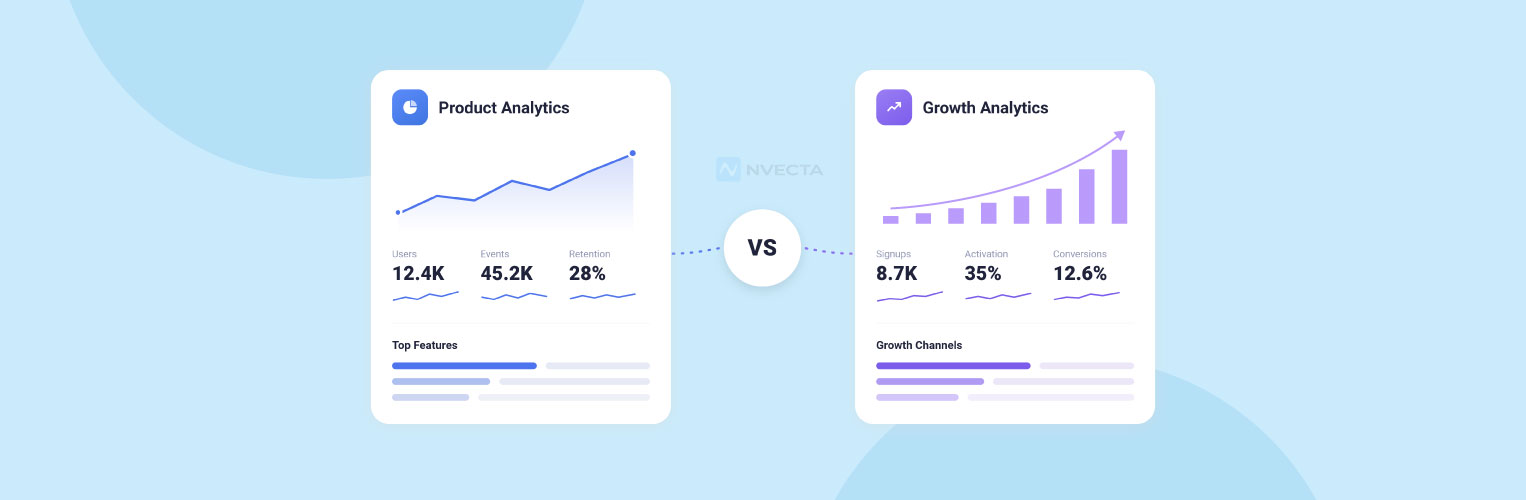
 Aparupa Saha
Ask five people at your company what product vs growth analytics actually means. You’ll get five answers. Maybe six, if someone changes their mind halfway through. Some will call it semantics. Others insist it’s one discipline wearing two hats. Both wrong. NVECTA’s AI-powered customer data platform and engagement platform pulls both layers into a single system, and honestly, that’s because most teams never sort out the distinction on their own.
So here’s the blunt version. Product analytics wants to know if the thing you built works. Growth analytics wants to know if the right people are showing up and staying. Mix those two questions up, and weird things happen. You start optimising for engagement that never touches revenue. Or you celebrate signup numbers while the product quietly loses people out the side door.
Let’s pull this apart properly.
Product Analytics
Product analytics lives inside the product itself. Not around it, not near it. Inside. Feature adoption. The exact step where someone abandons a workflow. How many clicks before a new user hits their first real “aha” moment?
This is the layer that answers whether a checkout redesign actually reduced cart abandonment. Or whether that onboarding tooltip everyone was so proud of is just… being ignored. By most people, most of the time.
Granular data. Click paths. Funnel completion rates. Retention curves sliced by feature usage. Amplitude, Mixpanel, tools like that exist for one reason: to keep asking whether the product is doing its job.
A few things it’s genuinely good at:
- Finding the exact drop-off point in a multi-step flow
- Telling you if a shipped feature got adopted, or just shipped and forgotten
- Flagging early actions that predict who sticks around long-term
- Splitting power users from casual ones so you’re not averaging two different populations together
What it can’t answer: why anyone showed up in the first place. Or what happens after they close the app for good.
Growth Analytics
Growth analytics zooms out. Further than you’d think. It doesn’t care about a single click so much as the whole machine, acquisition, conversion, retention, all of it spinning together.
Which channels bring people in. Signup-to-paid conversion. Churn broken down by cohort. Lifetime value stacked against acquisition cost. Referral loops, assuming your product has any worth tracking.
Growth teams run on tests. Pricing pages, landing variants, email sequences, onboarding nudges, anything that might move the needle.
Product analytics checks whether a feature worked. Growth analytics asks something colder: did this bring in more of the right customers, and did they stay long enough to actually be worth it?
This is where most companies get tangled, if we’re being honest. Growth data needs ad platforms, CRM records, billing systems, and in-app events all stitched together in one place.
Skip that stitching, and your growth report looks great in a slide deck. Explains almost nothing about why revenue actually moved.
You can use Google Slides AI to complex findings into polished presentations, however, the underlying data still needs to be connected properly.
Side by Side
| Dimension | Product Analytics | Growth Analytics |
| Core question | Does the product work? | Are we acquiring and keeping the right users profitably? |
| Primary metrics | Feature adoption, funnel completion, cohort retention | CAC, LTV, conversion rate, churn, MRR/ARR growth |
| Data sources | In-app events, click streams | Ad platforms, CRM, and billing, blended with app data |
| Typical owner | Product managers, UX researchers | Growth marketers, revenue ops |
| Time horizon | Short, feature-level | Medium to long, business-wide |
| Common tools | Amplitude, Mixpanel, Pendo | Google Analytics, CDPs, attribution tools |
| Failure mode | Features ship. Nobody uses them. | Churn outpaces acquisition. |
Look at the failure modes again. A product nobody uses eventually becomes a growth problem anyway. Churn creeps up. CAC payback stretches. Retention flattens out. Not really two separate worlds. Two lenses, same customer underneath.
Why Siloing These Backfires
Most mid-size companies split the two across different teams, tools, and data warehouses. Product analytics sits in Amplitude somewhere.
Growth analytics lives in a spreadsheet stitched together from Google Analytics exports and whatever Salesforce coughs up that week. The two never talk. So the company ends up with two competing versions of what’s actually true.
Here’s a scenario. Plays out constantly, in one form or another. Growth marketing runs a campaign, signups jump 40%, everyone’s thrilled.
Three weeks later, retention data (sitting somewhere else entirely, watched by a completely different team) shows that same cohort churning at double the usual rate. Nobody catches it until the quarterly review. Ad spend’s already gone by then. LTV damage is baked in.
Not a tooling failure, really. An integration failure. The data existed the whole time. It just never spoke up soon enough to matter.
Where They Have to Merge
Teams that actually get this right don’t pick a side. They build something where product signals inform growth decisions and growth signals inform product priorities. What that looks like:
Feature usage shapes who gets targeted next: Say product analytics shows users who touch a specific feature in their first week retain at three times the normal rate. Growth can build campaigns aimed directly at whoever’s most likely to find that feature early and stick with it.
Churn signals trigger something inside the product, before it’s too late: Growth analytics might catch a cohort’s engagement sliding well before anyone officially churns. Feed that back into the product layer, and you can fire a targeted nudge, an email, an in-app offer, while there’s still time to change the outcome.
One story about the customer, not two competing ones: Instead of growth claiming the signup and product claiming the retention separately, a merged view traces the entire path. Which channel brought them in, which feature triggered the real “aha” moment, and what ultimately decided whether they stayed.
Doing this without a system built for it from the start is hard. Genuinely hard. Most companies patch it together with exports and brittle API calls and a lot of manual reconciliation that quietly breaks the day someone forgets to update a pipeline.
How NVECTA Closes the Gap
This is the exact problem NVECTA was built around. Instead of forcing teams to choose between product-level behavioural data and growth-level acquisition data, NVECTA’s customer data platform combines both into a single real-time customer profile. Every in-app click. Every campaign touchpoint. Every conversion event. All landing in one system instead of three that don’t communicate.
From there, the AI Co-Marketer and AI Agents layer automatically act on that unified picture. Someone who shows strong early product engagement is routed straight into a retention-focused journey.
A cohort flashing churn risk, declining feature usage layered against acquisition source data, triggers a re-engagement push before they’re actually gone. Marketing Automation and CRO tools pull from that same customer record, so there’s no lag between what product analytics notices and what growth analytics does about it.
For teams tired of reconciling two dashboards to answer one question, that’s really the whole point. NVECTA doesn’t ask you to pick a side in the product vs growth analytics debate. It gives you both, wired together, acting the same day the data lands.
FAQs
What’s the main difference between product analytics and growth analytics?
Product analytics tracks what users do inside your product, feature adoption, funnel drop-off, and cohort retention. Growth analytics tracks how users get acquired, converted, and retained across the whole business, including CAC, LTV, churn, and conversion rates.
Can a company get by with just one type?
Technically, sure. Not smart though. Lean only on product analytics, and acquisition problems build up unnoticed. Lean only on growth analytics, and you miss why people are actually leaving, which is usually the real root cause underneath the churn number.
Who owns each side, typically?
Product managers and UX researchers usually run product analytics. Growth marketers and revenue ops usually run growth analytics. In more mature companies, the line blurs quite a bit, and both sides end up sharing data constantly.
What tools show up most on each side?
Amplitude, Mixpanel, and Pendo dominate the product side. Growth pulls more from Google Analytics, CRM platforms, ad dashboards, and increasingly CDPs that fold everything into one view.
How does a CDP tie the two together?
It consolidates behavioural, acquisition, and transactional data into a single customer profile. Nobody’s manually reconciling three separate systems just to answer one question anymore.
What’s the tell that a company is siloing badly?
When a growth win and a product loss (like elevated churn in the same cohort that just converted) get discovered separately, weeks apart, instead of showing up together in real time.
Is growth analytics just for early-stage startups?
No. The focus shifts, but it stays relevant. Early-stage companies lean hard on acquisition and conversion. Mature companies weigh retention, expansion revenue, and LTV more heavily as their real growth signals.
How often should these two teams actually sync?
Ideally never, in the scheduled-meeting sense, if the data’s already unified in real time. Short of that, weekly reviews of combined metrics are the bare minimum before blind spots begin to form.
