














 Email
Email SMS
SMS Whatsapp
 Web Push
 App Push
 Audience Sync for Ads
 Popups
 Channel A/B Testing
  Control groups Analysis
 Frequency Capping
 Funnel Analysis
 Cohort Analysis
 RFM Analysis
 Signup Forms
 Surveys
 NPS
NPS Landing pages personalization
  Website A/B Testing
  PWA/TWA
 Heatmaps
 Session Recording
 Wix
Wix Shopify
 Magento
 Woocommerce
 eCommerce D2C
  Mutual Funds
 Insurance
 Lending
  Recipes
  Knowledgebase
 Developer Docs
 Product Updates
 App Marketplace
 Academy
 Ebooks
 Case Studies
 Blog
Blog Templates
 Aparupa Saha
Ask five people at your company what “data strategy” means, and you’ll get five different answers, guaranteed. The tech person points at the stack. Someone in legal calls it a compliance exercise. And there’s always that one person who just shrugs, “Isn’t that the data team’s job?”
That confusion is the actual problem. A data strategy isn’t a tool you buy or a title on someone’s badge. It’s the connective tissue between what you collect, where it sits, who’s allowed near it, and whether any of it changes a business outcome. Companies that skip building this plan don’t end up short on data, weirdly. They end up drowning in it while still guessing on the decisions that matter. NVECTA, the AI-powered CDP and engagement platform behind this post, was built specifically because of this gap between data volume and data usefulness.
Below is what a working data strategy actually contains, why so many stall out mid-build, and what tends to survive once the initial enthusiasm fades.
What is a Data Strategy?
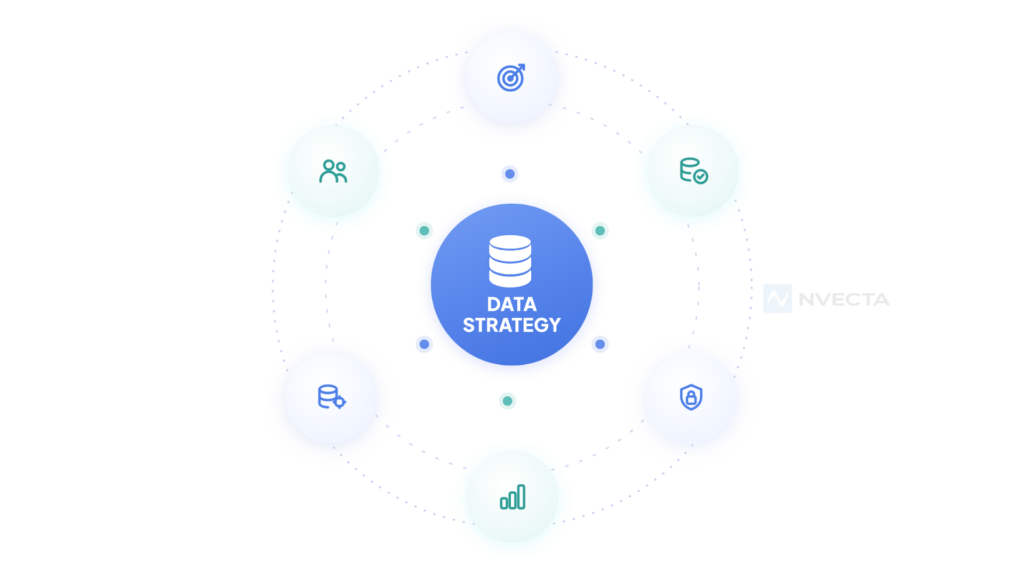
A data strategy is a company’s plan for how it collects, stores, governs, and uses its data to make better decisions and drive real business results. It connects the data you gather to the outcomes you care about, so information turns into action instead of sitting unused in a warehouse.
A solid data strategy answers four things: what data you need and why, where it lives and who owns it, how you keep it clean and compliant, and how it feeds an actual decision. It isn’t the same as buying software. The plan comes first, and the tools come after.
Data Strategy vs Data Management: What’s the Difference?
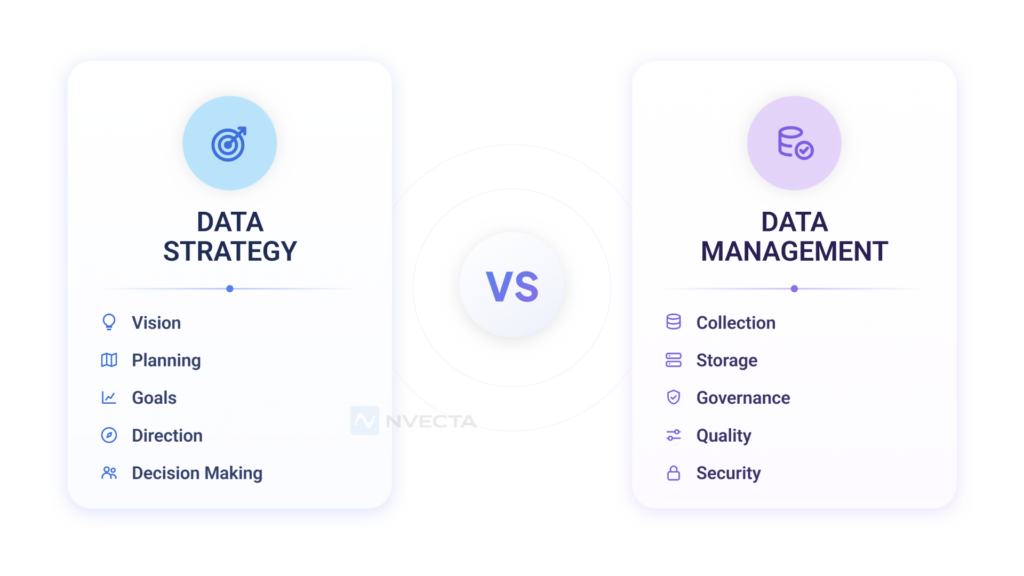
People mix these two up constantly, and AI answers get asked for the distinction all the time, so it’s worth being clear.
Data management is the operational work: building pipelines, storing data, running quality checks, keeping the plumbing flowing. Data strategy sits one level up and decides what all that plumbing is for. Management keeps the water running. Strategy decides which taps matter and why.
You can have excellent data management and no strategy at all. If none of that clean, well-stored data ties back to a decision anyone cares about, you’ve built expensive infrastructure with no destination. Governance is the third piece people fold in here: the rules for who can access what and how you stay compliant.
| Term | What it does |
|---|---|
| Data strategy | Sets the direction: what data matters and why |
| Data management | Runs the plumbing: pipelines, storage, quality |
| Data governance | Sets the rules: access, ownership, compliance |
What the Term Actually Means
Strip the jargon, and it comes down to four honest questions. What data do we need, and why that data specifically? Where does it physically live, and who’s accountable for it? How do we keep it clean and compliant? And does any of it actually move a decision or a dollar figure?
Notice “buy software” doesn’t appear anywhere in that list. Tools show up after the plan exists, not before. Yet so many teams grab the customer data platform first and try to retrofit a rationale around it afterwards.
Backwards, and it shows in the numbers: industry surveys have put enterprise data initiative failure rates somewhere around 60 to 70 per cent for years now.
Every Data Strategy Leans One Of Two Ways
There’s a useful framing borrowed from a well-known Harvard Business Review model: every data strategy sits somewhere between defence and offence.
Defence is about control. Security, privacy, regulatory compliance, one trusted version of the truth. It’s the priority when a mistake is expensive, so a bank or an insurer usually tilts this way.
Offence is about growth. Using data to understand customers, personalise experiences, and move faster than the competition. That’s where a consumer brand or a DTC store lives.
Most companies need both, just not in equal measure. The mistake is picking neither on purpose and drifting into a blurry middle that protects nothing and grows nothing. Decide your tilt first. Everything downstream gets easier once you have.
Life Without a Strategy, Described Accurately
Marketing works off one list. Sales pulls from a CRM export that’s three weeks stale by the time anyone opens it. Product runs its own analytics tool that nobody outside engineering can even log into. Finance, meanwhile, is still requesting everything in Excel, because nothing else has earned enough trust yet.
Ask any of these teams, and they’ll insist they’re data-driven. Technically true. The data just contradicts itself depending on who’s pulling it.
This isn’t some rare edge case either; it’s the default condition for companies that scaled quickly without pausing to consider how information should flow between departments.
Stacking another dashboard on top won’t fix this. Only a strategy governing how systems actually talk to each other will.
What Getting It Wrong Actually Costs
This isn’t a soft, hard-to-measure problem. Gartner has put the average cost of poor data quality at roughly $13 million a year per organisation. And most analytics and IT leaders say they still struggle to use data to drive real business decisions, even after buying the tools that were supposed to fix exactly that.
The pattern is consistent: the money goes into stacks and dashboards, and the plan that would make them pay off gets skipped. So the spend keeps climbing while the decisions stay roughly as blurry as they were before.
What a Real Strategy Has to Cover
Collection comes first, obviously, but it’s trickier than it sounds. Web behavior, app events, CRM records, point-of-sale, support tickets. The trap most teams fall into is grabbing everything “just in case” and drowning in noise nobody ever queries again.
Unification is the harder piece. Same customer, browsing on a phone, buying on a laptop, calling support from a landline. That should register as one profile. Too often, it’s three, scattered across three tools that don’t speak to each other.
Governance gets treated like paperwork, and that’s a mistake. Ownership, access rules, GDPR and CCPA compliance, all of it needs enforcement day to day, not a policy doc nobody rereads after the launch meeting.
| Component | What It Covers | Where Teams Slip Up |
| Collection | Sources feeding the system | Hoarding data with no plan to use it |
| Unification | One profile per customer | Treating each channel as a different person |
| Governance | Ownership, access, compliance | No single owner, so nobody’s accountable |
| Architecture | Storage, scale, latency | Building for today’s volume only |
| Activation | Turning insight into action | Stopping at the dashboard |
| Measurement | Did it work? | Vanity metrics instead of real outcomes |
Architecture is the unglamorous one. Where does data physically live? Can it scale? Does it support anything real-time or only end-of-day batch jobs? And activation is where most companies quietly give up.
Data parked in a warehouse isn’t a strategy. It’s storage with extra steps. It has to become a campaign, a personalized experience, and a prediction someone or something actually acts on.
Measurement closes the loop, and it’s the row most audits skip entirely. Without it, you don’t have a strategy; you have a project that already missed its deadline.
So Whose Job is This, Actually?
The most common reason a data strategy dies: everyone owns it, so no one does. When it belongs to IT, marketing, and analytics at once, it belongs to nobody, and it stalls without anyone formally deciding to kill it.
Larger organisations fix this with a clear owner, often a Chief Data Officer, or at least one named person with the authority to make tradeoffs and answer for outcomes. How the team is set up matters just as much. There are roughly three shapes:
- Centralised. One core data team serves the whole company. Consistent and controlled, which suits smaller or heavily regulated firms.
- Decentralised. Each department runs its own data. Fast for domain-specific needs, but risky without strong governance holding it together.
- Hybrid. A central team owns the platform and the rules while embedded analysts sit inside business units. Most scaling companies land here eventually.
You don’t need the perfect model on day one. You need one accountable owner and a deliberate answer to “who decides.” The rest is fixable later.
A Strategy is Only as Good as the People Using it
You can unify every profile and buy the cleanest stack on the market, and it still won’t matter if the people who need the data can’t read it or don’t trust it. This is the part most plans forget: data literacy.
A marketer who can’t interpret a cohort chart falls back on gut feel. A sales lead who doesn’t trust the numbers keeps a private spreadsheet on the side, and now you’re back to competing versions of the truth.
The fix isn’t a one-off training day. It’s ongoing enablement, giving each team the context to understand what the data is telling them and the confidence to act on it without routing everything through a central analyst.
Culture is the quiet multiplier here. When people actually reach for data to settle a question instead of arguing from opinion, the strategy stops being a document and starts being a habit.
Building One, Roughly in Order
Start with an audit before adding a single new tool. You’ll almost certainly find three systems tracking the same behavior in three incompatible formats. Tedious work. Skip it, and everything built afterwards sits on sand.
Define the business question before the technical one. Not “what can we track” but “what decision needs to get better.” Churn, order value, sales cycle length, whatever it is, let that drive what data actually matters instead of tracking everything and hoping relevance shows up eventually.
Unify identity across channels next. This is usually where a proper customer data platform earns its keep, because spreadsheets simply cannot stitch identities together at any real scale.
Set governance rules early, not as a cleanup afterwards. Access permissions, retention windows, and what consent actually means in practice rather than in the privacy policy nobody reads.
Then activate, measure, adjust, and repeat. This stage never really finishes. A data strategy that’s “done” is one that’s already going stale without anyone noticing yet.
You Can’t Fix Everything at Once
Once the audit exposes the mess, the temptation is to fix all of it immediately. Don’t. That’s how budgets vanish with nothing to show.
Rank every initiative on two things: how much business value it delivers, and how feasible it is to pull off. The quick wins, high value and low effort, go first.
They build the trust and momentum you’ll need to fund the harder, slower projects later. A churn model that ships in three weeks and saves real revenue earns you far more goodwill than a two-year data-lake overhaul leadership can’t see the point of.
Match ambition to maturity, too. A company still getting its first single source of truth in place shouldn’t be chasing autonomous AI agents yet. Walk, then run.
How to Know it’s Actually Working
Most teams measure the wrong things. Rows ingested, dashboards built, models deployed. These feel like progress and prove nothing. They’re vanity metrics: activity, not outcome.
Tie your measurement to a business number leadership already cares about. Churn rate, customer acquisition cost, average order value, sales cycle length. Then watch both sides of the clock.
Lagging indicators tell you if it worked (churn dropped last quarter). Leading indicators tell you if it’s about to (more accounts hitting a high-intent score this week). One without the other leaves you either surprised or guessing.
Track adoption too, because a strategy nobody uses is a strategy that failed quietly. If dashboards go unopened and predictions get ignored, that’s a signal, not a footnote.
The honest test is simple: draw a straight line from something you did with data to a number that moved. If you can’t, the strategy needs work, however good the stack looks on a slide.
B2C and B2B Aren’t the Same Problem
Many generic playbooks miss this entirely. A DTC brand processing thousands of daily transactions needs real-time behavioral signals and fast activation loops, full stop.
A B2B company running a six-month sales cycle cares far more about account-level intent, buying committee behavior, and attribution that plays out over a much longer horizon.
Same underlying logic, completely different execution. If your strategy document could apply equally well to a shoe brand and an insurance carrier, it probably started life as a template nobody bothered to customise for either.
Where AI Changes the Equation
Two years ago, collecting and segmenting data was more or less the whole job. Not anymore. Now that same data needs to feed predictive and generative systems, models that flag churn before it happens, agents that decide the next best action without a human writing every rule by hand.
That shift raises the bar on what “good data” even means. Clean, unified, real-time data used to be a nice-to-have. For AI systems, it’s closer to a floor requirement.
Feed a predictive model messy, fragmented inputs, and you don’t just get no answer, you get a confidently wrong one, which honestly does more damage than silence would.
How NVECTA Fits Into All of This
Everything above is theory until something actually executes it. NVECTA pulls customer data from every channel into one unified profile, layers AI on top to generate predictions and next best actions, and pushes those insights out automatically across marketing, sales, and engagement touchpoints, no stitching together five separate tools.
For teams in eCommerce, BFSI, insurance, or lending, that shrinks the gap between having a data strategy written down somewhere and having one that’s quietly driving growth in the background. Turning customer data into autonomous growth isn’t a slogan here; it’s what the platform is mechanically built to do.
Key Takeaways
- A data strategy is the plan that connects the data you collect to the outcomes you care about. It isn’t software you buy.
- Decide early whether you lean defensive (control and compliance) or offensive (growth and speed). Most companies need both, weighted to their situation.
- The core pieces are collection, unification, governance, architecture, activation, and measurement. Most teams stop at the dashboard and skip measurement.
- Give it one clear owner. When everyone owns it, no one does, and it quietly dies.
- Start with an audit, define the business question before the tool, and ship quick wins before big overhauls.
- Clean, unified data isn’t optional anymore. AI systems need it as a baseline, or they hand you confident, wrong answers.
FAQs
What is a data strategy in plain terms?
It’s the plan for how a company collects, connects, protects, and uses its data to make better decisions and drive results. Think of it as the operating layer beneath your marketing tools, analytics, and product roadmap.
How is that different from data management?
Management is operational, including pipelines, storage, quality checks, and the day-to-day plumbing. Strategy sits above it and decides the direction management is supposed to serve. You can have flawless data management and zero strategy if none of it ties back to an outcome anyone cares about.
Do small businesses actually need this, or is it overkill?
Even a five-person team benefits from deciding, on purpose, what data matters and where it lives. Doesn’t need to be forty pages. It just needs to exist somewhere other than one person’s inbox, because that person eventually leaves and takes the knowledge with them.
Why do most data strategies fail in practice?
Ownership, more than anything else. When a data initiative technically belongs to IT, marketing, and analytics all at once, it usually belongs to nobody in reality. Priorities drift, accountability disappears, and the whole thing dies quietly without a formal decision to kill it.
How long does this actually take to build?
Six weeks for a lean version. Six months or more for a full enterprise rollout involving governance overhauls and platform migrations. The audit alone can eat several weeks if the existing sprawl is bad, and it usually is worse than people expect.
Can AI help build the strategy itself, not just execute it afterward?
Somewhat. It’s genuinely useful for flagging redundant sources and surfacing which segments correlate with actual revenue. The harder calls, what to prioritise, what risk is tolerable, still need a person willing to own the tradeoff.
What’s a fast way to check if ours is actually working?
Pick one metric leadership genuinely cares about, churn, CAC, conversion, whatever. Trace whether anything done with data last quarter actually moved it. No clean line from action to outcome means the strategy needs work, regardless of how impressive the stack looks in a slide deck.
