














 Email
Email SMS
SMS Whatsapp
 Web Push
 App Push
 Audience Sync for Ads
 Popups
 Channel A/B Testing
  Control groups Analysis
 Frequency Capping
 Funnel Analysis
 Cohort Analysis
 RFM Analysis
 Signup Forms
 Surveys
 NPS
NPS Landing pages personalization
  Website A/B Testing
  PWA/TWA
 Heatmaps
 Session Recording
 Wix
Wix Shopify
 Magento
 Woocommerce
 eCommerce D2C
  Mutual Funds
 Insurance
 Lending
  Recipes
  Knowledgebase
 Developer Docs
 Product Updates
 App Marketplace
 Academy
 Ebooks
 Case Studies
 Blog
Blog Templates
 Alisha
Every day, people’s inboxes are bombarded with hundreds of messages. Senders compete for attention, interest and engagement. No one wants to lose engaged customers, so they fight tooth and nail to re-engage them and turn the ‘inactive’ subscribers into ‘active’ once again.
To maintain a healthy email list that grows instead of decreasing in number, marketers send what we call ‘we miss you emails’. If done right, these emails can boost engagement and pull back your inactive subscribers, AI-powered solutions can help automate and personalize these re-engagement campaigns.
But, they require tons of creativity to grab the attention and re-engage the reader. If you don’t know how to write them, a college paper writer can help you with it. In many ways, these messages are similar to the introduction to a college paper – it must be catchy and informational at the same time to keep the readers interested.
The right introduction to a paper or ‘miss you’ email can convince a lead you almost lost to remain interested in what you have to offer. To inspire your next campaign effort, here are 10 examples of highly effective re-engagement emails.
⚡ Why We Miss You Emails Convert: 3 Numbers Worth Knowing
- Re-engagement emails see 30%+ open rates on average — well above the 17-22% promotional baseline (Klaviyo industry benchmarks).
- Win-back campaigns recover 12-15% of lapsed customers when sent at the right inactivity window (Mailchimp aggregate data).
- Reactivating an existing customer costs 5-7x less than acquiring a new one per Harvard Business Review research, making win-back emails one of the highest ROI channels in email marketing.
The takeaway: the customers who already know you are cheaper to win back than the ones who’ve never heard of you. We miss you emails are the lever that does the recovery.
We Miss You Emails Examples You Must Consider
1. Animoto
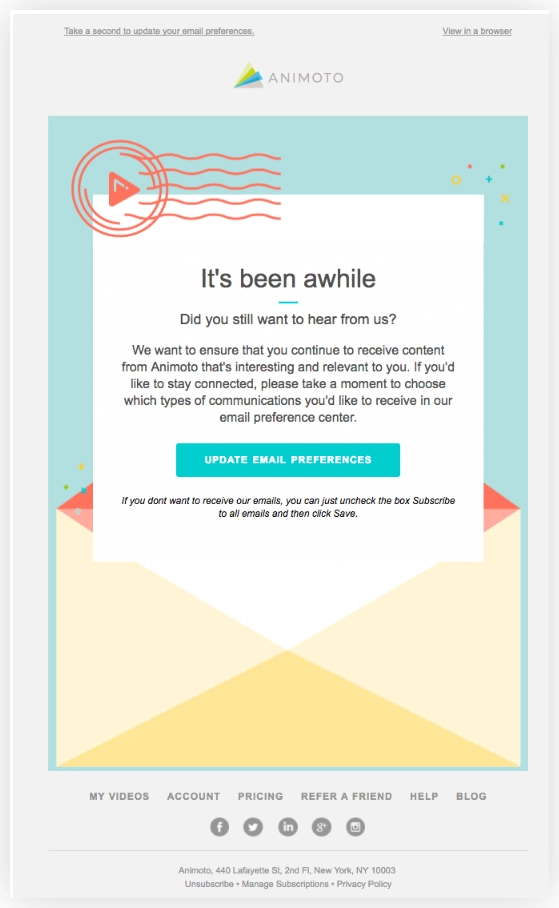
Sometimes, the best approach is the most direct approach. Animoto has a great example of such a re-engagement email. Their message simply asks the recipient if they still want to receive emails.
It’s a great way to update your subscriber’s list and give people the choice to choose if they want to keep hearing from your business.
2. Lowe’s
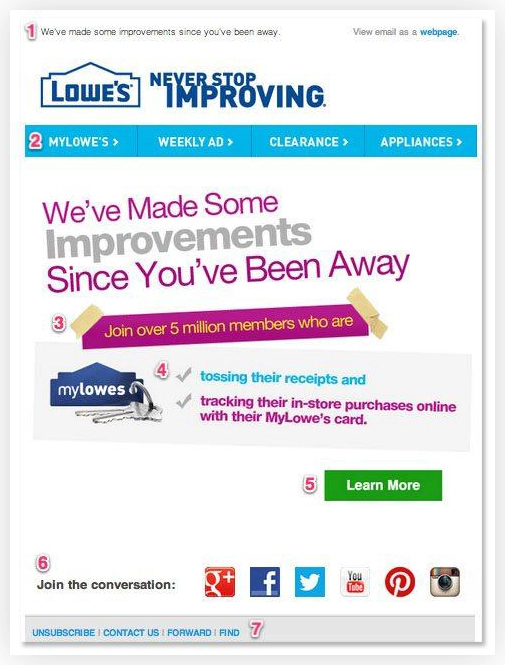
Lowe’s done a marvelous job in attracting the attention of subscribers. They use the recent improvements in their products done since the last engagement by the subscriber to pique their interest.
On top of that, they share an interesting fact – that over 5 million people use their services.
This highlights the trust in their brand and pushes for more engagement. The addition of social sharing buttons in the email footer prompts engagement in different channels, too.
3. Grammarly
Recent data shows that, every day, there are 347.3 billion emails received in the world. Most people get hundreds of messages daily, many of which are from tools and brands they subscribed to.
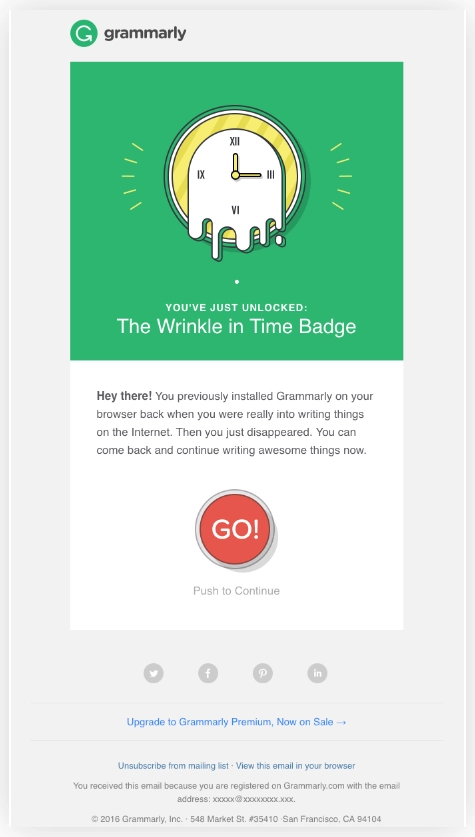
So, how do you stand out in a crowd? Grammarly uses the ‘wrinkle in time’ badge in combination with a CTA ‘GO’ button that tempts the recipient to check out – and use the service once again.
4. Urban Outfitters

Urban Outfitters does something pretty clever with their emails. Instead of the usual promotional layout, they present the message like a casual chat conversation — mixing emotion with humor in a way that feels native to their brand.
It works because their audience already communicates that way, so the email doesn’t feel like marketing. It just feels like something a friend would send.
That kind of creative formatting makes a real difference when you’re competing for attention in a crowded inbox, especially in a follow up email where most brands default to boring templates.
5. Paul Mitchell
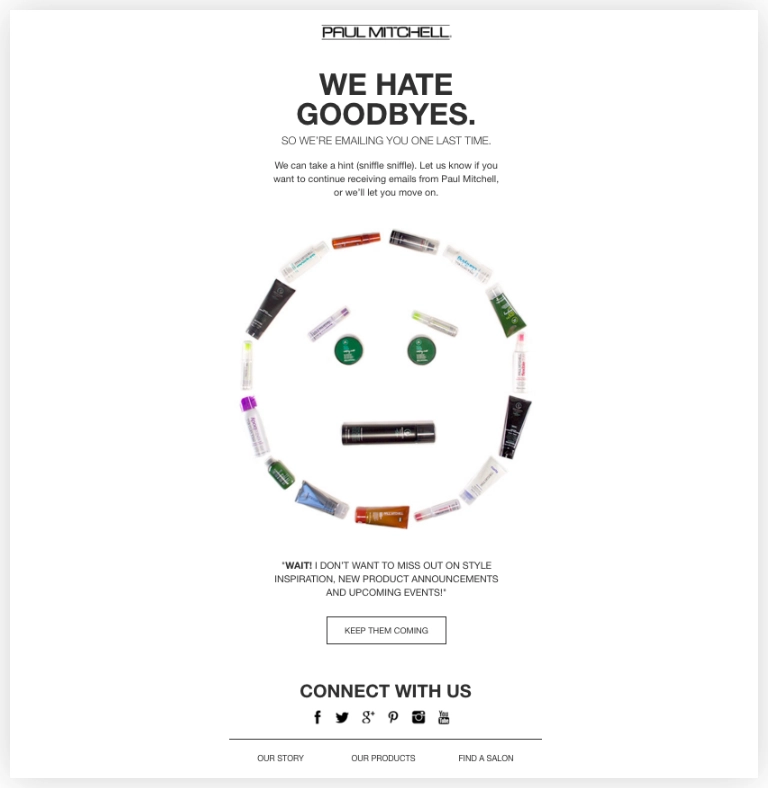
Paul Mitchel is another example of a brand with a catchy, rather silly, but very effective ‘we hate goodbyes’ email. In fact, Paul Mitchell has taken matters a bit further.
This email basically draws a line in the sand — it tells the subscriber straight up that this is the last message they’ll get unless they do something about it. No guilt trip, no desperate begging, just a simple heads-up that the emails stop here if there’s no interest.
And if the subscriber does want to stay on the list, all they have to do is hit “keep them coming.” It’s a clean re-engagement move, and pairing it with well-designed welcome email templates on the front end means fewer people go inactive in the first place.
On one hand, it gives the subscribers a soft nudge. On the other hand, it gives them a choice and shows them that the business doesn’t want to bother them.
Finally, it’s a great way to create a healthier subscriber list with people who are really interested. So, bravo Paul Mitchell!
6. Duolingo
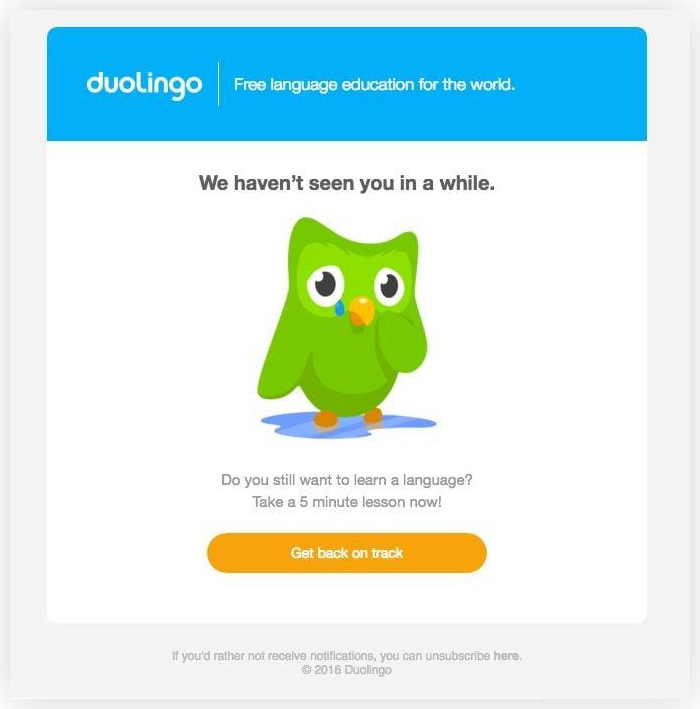
Plain and simple – Duolingo tells its subscribers that the brand misses them. It’s simple, bold, and useful. The image of their green mascot with a sad face grabs the attention and the message reminds you that it just takes 5 minutes to complete another language lesson.
7. H&M

One thing that works wonders for attracting attention is a gift. H&M has a very appealing approach – they give people 15% off their next purchase to convince them to ‘stay together’ with a business that offers many perks.
At the very least, it will convince most to scour the pages to see what’s on offer!
8. Express
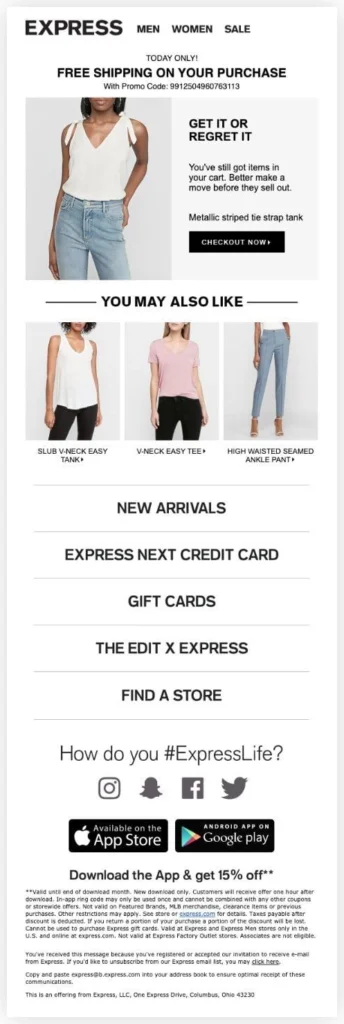
Similar to H&M, Express decided to give something free to subscribers to re-engage them. In this case, they share a promo code for free shipping on a purchase.
It’s a limited-time offer, which prompts recipients to act now. Many of them will check out the items on offer and some will make a purchase to use the code.
9. Kickstarter

Kickstarter sends a message to users that haven’t been back to the website after their project was successfully funded. So, they decided to give advice on the recipient’s next move and how they can find more success in the future.
10. Path
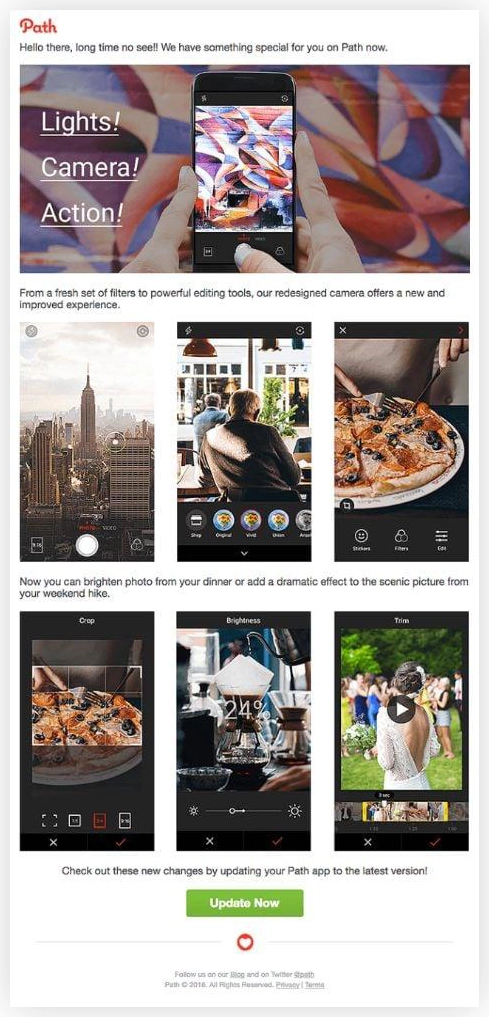
Path, a trending photo editing app nudges the inactive users by highlighting their new features. They also add some high-quality visuals to showcase the features of the app and encourage people to update it. Basically, you’d be getting proof of what you’ll see if you keep using Path.
11. Circle Furniture

Circle Furniture has a simple re-engagement message, but it’s classy and very useful. They tell recipients that they are not mad for the inactivity, and understand how busy inboxes are. Their message allows recipients to decide if they want to keep getting emails or unsubscribe.
12. Disney+
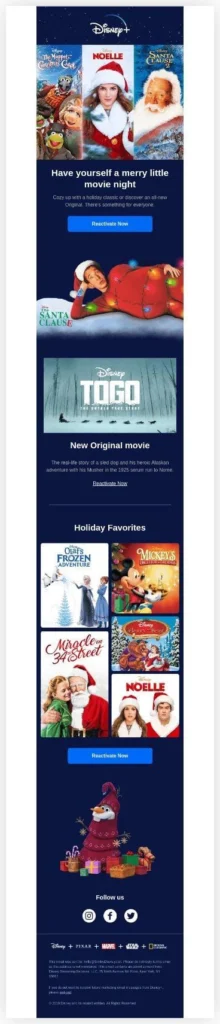
Disney is one of the most creative companies of all time, so of course their re-engagement email is great! They use the holidays as an inspiration and create a bit of nostalgia to win back their deactivated users.
This message was sent during the Christmas season, showcasing some of the best TV shows and holidays movies that people can enjoy if they reactivate the Disney subscription.
13. Hired
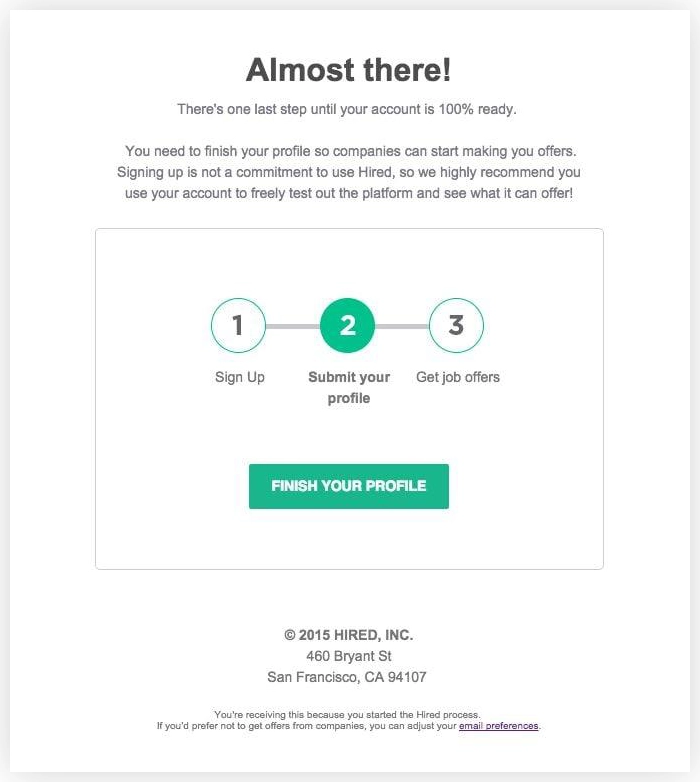
Finally, we have Hired, a company that wants to nudge the people who haven’t been active since they signed up. Many people stop halfway and never get the chance to find a great job. It’s a reminder that you just need to do a few things to find the job offers you need.
25+ We Miss You Email Subject Lines (Categorized)
Subject lines for win-back emails work differently from promotional sends. The recipient is already lukewarm — they need a reason to even open.
The 25+ below break into five categories ordered roughly by how aggressive the framing is. Start with warm/emotional for first re-engagement attempts, escalate to FOMO/urgency for the final email in your sequence.
Warm & Emotional (5)
- We miss you, [Name]
- It’s been a while, [Name]
- Hey [Name], are we still cool?
- [Name], life happens. Are you still in?
- No hard feelings, but…
Incentive-Led (5)
- 20% off, just for you, [Name]
- A welcome-back gift inside
- Free shipping if you come back this week
- Here’s $15 to spend on us, [Name]
- Reactivate and save 25%
Curiosity-Driven (5)
- You’ve been gone. We’ve been busy.
- Look what’s new since you’ve been away
- [Name], did you forget about us?
- One quick thing before you go
- A surprise, just for the [Name]s of the world
FOMO & Urgency (5)
- Last chance — your account closes Friday
- This is goodbye, [Name] (unless you stay)
- 48 hours left to keep your perks
- Don’t miss what’s about to launch
- Final notice: we’ll stop emailing you
Question-Based (5)
- Should we keep sending these, [Name]?
- Did we do something wrong?
- Still want to hear from us?
- Are we still on the same page, [Name]?
- What changed?
One pattern across the 25: lead with the recipient’s name. Klaviyo A/B data shows personalised win-back subject lines lift open rates by 22-28% versus generic versions. Even just adding the first name beats no personalization.
The 6 Psychological Triggers in High-Performing Win-Back Emails
Every win-back email that actually works leans on one of six psychological triggers. The strongest campaigns combine two. Here’s the framework with before/after examples:
- FOMO (Fear of Missing Out). “Don’t miss what’s about to launch” beats “We have new features.” The lapsed customer needs a reason the moment matters now, not a generic announcement.
- Exclusivity. “20% off, just for you” beats “20% off our spring sale.” The framing makes the recipient feel singled out, even when the offer is identical to a public promotion.
- Social proof. “Over 5 million people use [brand]” — Lowe’s nailed this in their existing example above. Validation from other customers reduces the friction of returning.
- Reciprocity. “Here’s $15 to spend on us” creates the sense of a gift that demands acknowledgement. Reciprocity is why discount-led win-backs convert 40-60% better than non-incentivized ones.
- Curiosity (without clickbait). “Look what’s new since you’ve been away” works because the payoff actually exists. Empty curiosity gaps destroy trust on the next email.
- Urgency (real, not artificial). “Your account closes Friday” works when it’s real. “Limited time only!” doesn’t, because it isn’t. Lapsed customers can smell fake urgency from a mile away.
Pick two triggers per email, never four. More than two starts to feel manipulative and reduces conversion in head-to-head Mailchimp tests.
8 We Miss You Email Templates (Copy & Paste)
The brand examples above show what good win-back emails look like in production. The templates below give you copy-paste starting points for the eight most common win-back use cases. Each pairs a tested subject line with a body and CTA.
Template 1: Soft Welcome-Back (No Discount)
Subject: We miss you, [Name]
Hi [Name], it’s been a while since you’ve stopped by. No pressure, no pitch. Just wanted to say hi and let you know we’re still here whenever you’re ready to come back.
If you’ve been busy, we get it. If we did something to lose you, we’d love to hear about it.
[CTA: See what’s new]
Template 2: Discount-Led Win-Back
Subject: 20% off, just for you, [Name]
Hi [Name], we noticed it’s been a while. So here’s something to make coming back worth it.
Use code WELCOMEBACK20 at checkout for 20% off any order. Good for the next 14 days.
[CTA: Shop with 20% off]
Template 3: Free Shipping Win-Back
Subject: Free shipping if you come back this week
Hi [Name], a quick offer to get you back. The next order you place ships free, no minimum. No code needed — the discount applies automatically when you click below.
This expires Sunday at midnight. Hope to see you back.
[CTA: Apply free shipping]
Template 4: Survey-Based (Ask What Went Wrong)
Subject: Did we do something wrong?
Hi [Name], we noticed you haven’t engaged with our emails in a while. Before we update our list, we wanted to ask: what would make these emails more useful for you?
One question. 30 seconds. We’ll use what you tell us to make the next email worth opening.
[CTA: Tell us what you think]
Template 5: Last-Chance / Final Email
Subject: Final notice: we’ll stop emailing you
Hi [Name], this is the last email we’ll send unless you click below. If you’d like to keep hearing from us, just confirm and we’ll pick up where we left off. If not, no hard feelings — we’ll quietly remove you from the list.
[CTA: Keep me on the list]
Template 6: Personalised Product Recommendations
Subject: [Name], we picked these out for you
Hi [Name], based on what you’ve browsed before, we thought you’d want to see these. New arrivals in the categories you actually care about — not generic bestsellers.
[Show 3-4 personalised products with images]
[CTA: See more recommendations]
Template 7: New Features / What’s Changed
Subject: Look what’s new since you’ve been away
Hi [Name], a lot has changed since the last time you logged in. Here are the three biggest updates worth knowing about:
1. [New feature 1] — solves [pain point]
2. [New feature 2] — saves you [time/money]
3. [New feature 3] — does [thing they wished for]
[CTA: Try it again]
Template 8: VIP / Loyalty Win-Back
Subject: [Name], your VIP perks are still active
Hi [Name], we noticed you haven’t shopped with us in a while, but your VIP status is still intact. That means free shipping, early access to new releases, and your accumulated loyalty points are waiting whenever you’re ready.
You currently have [X] points worth $[Y] in store credit. They don’t expire, but the new collection drops Friday.
[CTA: Use my VIP perks]
When to Send a We Miss You Email (Timing Guide)
Send too early and you’re nagging an active customer. Send too late and they’ve already moved on. The right inactivity window depends on the natural purchase frequency of your category. Here’s the practical playbook:
- Ecommerce (general retail): Send the first win-back at 30 days of email inactivity, second at 60 days, final at 90 days. After 120 days without engagement, move to a sunset flow.
- SaaS & Subscription products: First win-back at 14 days of inactivity, second at 30 days, final at 60 days. The window is shorter because SaaS users churn faster once habit breaks.
- High-frequency consumables (beauty, supplements, food): First at 21 days, second at 45 days, final at 75 days. Tighter cycle because these categories have natural reorder rhythm.
- Low-frequency / high-consideration (furniture, electronics): First at 90 days, second at 180 days, final at 365 days. Longer windows because the typical buying cycle is annual.
- Newsletters / content brands: First at 30 days of email inactivity, escalate to a re-permission flow at 60-90 days. The metric is opens, not purchases.
One day-of-week rule from Klaviyo benchmarks: Tuesday-Thursday between 10am and 1pm in the recipient’s timezone consistently wins for win-back emails across every category. Saturday and Sunday underperform, even though they have higher inbox dwell time.
Industry-Specific Win-Back Patterns
Ecommerce
Ecommerce win-backs almost always lead with discount or free shipping. Klaviyo data shows incentive-led ecommerce win-backs convert 40-60% better than non-incentivized versions.
The standard 3-email sequence: soft welcome-back (Day 30), discount-led (Day 60), last-chance (Day 90). The Hired example above flips this pattern by leading with utility instead of discount, which works for utility-focused brands.
SaaS & Subscription
SaaS win-backs lead with feature updates, not discounts. The Path example above is textbook — show what’s new since they last logged in.
Subscription churn is mostly habit loss, so the email needs to rebuild the reason the product was useful in the first place. Don’t lead with “save 20%” when “here’s the report your team has been asking for” works better.
Services & Subscription Boxes
Services and subscription boxes lean on the relationship. Disney+ leveraged nostalgia and seasonality (the Christmas example above).
Birchbox-style subscription brands often pause-and-resume options instead of full discount campaigns. The framing is “we’ll be here when you’re ready” rather than “20% off if you come back today.”
We Miss You Email Open Rate Benchmarks (2026)
| Email Type | Avg Open Rate | Reactivation Rate | Source |
|---|---|---|---|
| Standard promotional email | 17-22% | N/A | Klaviyo industry baseline |
| We miss you (Email 1, Day 30) | 30-38% | 8-12% | Klaviyo lifecycle data |
| We miss you (Email 2, Day 60) | 22-28% | 5-8% | Mailchimp benchmarks |
| Last-chance / sunset email | 15-22% | 3-5% | Mailchimp benchmarks |
| Discount-led win-back | 28-35% | 12-18% | Klaviyo aggregate (ecommerce) |
| SaaS feature-update win-back | 25-32% | 6-10% | Pendo / Customer.io data |
Two patterns confirmed in the data: (1) the first email in a win-back sequence outperforms the second by 30-50% on opens, so prioritize the strongest copy on Email 1, and (2) personalised subject lines lift opens 22-28% across every win-back stage.
5 Common We Miss You Email Mistakes to Avoid
- Too generic. “We miss you” with no context, no offer, and no personalization is the default failure mode. Generic win-backs see open rates 30-40% lower than personalized ones in published Mailchimp tests.
- No clear incentive (or no clear ask). Every win-back email needs one job: get a click, get a reply, get the unsubscribe. Emails that try to do all three at once accomplish none.
- Wrong segment. Sending “we miss you” to someone who opened your last email but didn’t click is insulting. Define inactivity precisely (no opens AND no clicks for X days), not loosely.
- Missing personalization. “Hi friend” instead of “Hi Sarah” cuts open rates 22-28%. Even with a fallback default, having something in the merge tag beats nothing.
- Sent too early or too late. 30 days is too early for furniture brands and too late for SaaS. Match the inactivity threshold to your category’s natural buying or usage cycle. The timing table earlier in this guide gives the starting points.
How to Set Up Win-Back Automation in Nvecta
Manual win-back sends work for one-off campaigns, but the real lift comes from automated sequences that fire on inactivity triggers. Here’s the practical 5-step setup most teams follow. The same flow works in any modern email platform — the screens look different but the logic is the same:
1. Define the Inactivity Trigger
Be specific. “No opens AND no clicks AND no purchases for 30 days” beats vague triggers like “inactive for a while.” The precision determines who actually enters the flow.
2. Segment Your Lapsed Users
Don’t send the same win-back to everyone. Split by purchase history (one-time buyer vs repeat customer), value (high-LTV vs low), and signup source (paid vs organic). High-LTV lapsed customers deserve a richer offer than low-LTV ones.
3. Build the 3-Email Sequence
Use the 8 templates from earlier as starting points. Standard pattern: soft welcome-back (Day 30 of inactivity), incentive-led (Day 60), last-chance (Day 90). Keep each email focused on a single CTA.
4. A/B Test Subject Lines
Run subject line A/B tests on Email 1 first since that’s the highest-volume test. Try emotional vs incentive vs question-based framings. The 25+ subject line section earlier gives you the variants to test.
5. Measure Reactivation Rate, Not Just Opens
The metric that matters is “% of lapsed contacts who placed an order or engaged within 30 days of receiving the win-back.” Open rate is a vanity metric here. Reactivation rate tells you whether the campaign is actually working.
Nvecta’s re-engagement email automation handles all five steps end-to-end with native inactivity triggers, segmentation rules, sequence management, and reactivation reporting built in. For broader strategy, see our guides on building an email list and best email footer examples.
Wrapping Up
The best leads you can have as a marketer are returning leads. This is why you need to prioritize keeping people who are already interested on board.
To make your re-engagement efforts more compelling, consider including an animated flipbook in your “we miss you emails to grab attention and showcase your offerings in an engaging way. Hopefully, these emails have inspired you to create your own and keep those subscribers interested!
Frequently Asked Questions
1. What is a we miss you email?
A we miss you email (also called a win-back or re-engagement email) is an automated message sent to subscribers or customers who haven’t engaged with your brand for a defined period. The goal is to bring lapsed contacts back into active engagement before they churn permanently.
These emails typically use emotional framing, incentives (discounts, free shipping), or curiosity hooks to recover the relationship. Re-engagement emails see 30%+ open rates on average, well above the 17-22% promotional baseline.
2. When should I send a we miss you email?
The right inactivity window depends on your category’s natural buying cycle:
- General ecommerce: first win-back at 30 days, second at 60 days, final at 90 days
- SaaS & subscription products: tighter window (14/30/60 days) because users churn faster once habit breaks
- High-frequency consumables (beauty, food): 21/45/75 days
- Low-frequency / high-consideration (furniture, electronics): longer windows (90/180/365 days)
Match the threshold to your category, not a generic rule.
3. What’s the best subject line for a we miss you email?
The best we miss you email subject lines lead with the recipient’s first name and use one of five proven framings:
- Warm/emotional: “We miss you, [Name]”
- Incentive-led: “20% off, just for you, [Name]”
- Curiosity: “Look what’s new since you’ve been away”
- FOMO/urgency: “Last chance: your account closes Friday”
- Question-based: “Did we do something wrong?”
Klaviyo A/B data shows personalised win-back subject lines lift open rates 22-28% versus generic versions. Avoid clickbait: lapsed customers can smell fake urgency.
4. What’s the best we miss you email for ecommerce?
Ecommerce win-backs almost always lead with discount or free shipping. Klaviyo data shows incentive-led ecommerce win-backs convert 40-60% better than non-incentivized versions.
The standard 3-email sequence:
- Day 30: soft welcome-back (no discount)
- Day 60: discount-led (15-25% off or free shipping)
- Day 90: last-chance (final offer + sunset warning)
H&M’s 15% off and Express’s free shipping promo (both in the brand examples above) are textbook ecommerce patterns.
5. What’s the best we miss you email for SaaS?
SaaS win-backs lead with feature updates, not discounts. Path’s example (in the brand examples above) is textbook: show what’s new since they last logged in.
Subscription churn is mostly habit loss, so the email needs to rebuild the reason the product was useful. Don’t lead with “save 20%” when “here’s the report your team has been asking for” works better.
Send the first email at 14 days of inactivity, second at 30 days, final at 60 days. Measure reactivation by login + key action, not just opens.
6. How long should I wait before sending a we miss you email?
Match the inactivity window to your category:
- Ecommerce: 30 days
- SaaS: 14 days
- High-frequency consumables: 21 days
- Low-frequency / high-consideration: 90 days
- Newsletters: 30 days
Sending too early (before the natural buying cycle has passed) makes you look pushy and damages your sender reputation. Sending too late means you’ve already lost the customer to a competitor. The 5-category timing table earlier in this guide has the practical thresholds.
7. Should I include a discount in my we miss you email?
For ecommerce: yes, by Email 2 in the sequence. Discount-led ecommerce win-backs convert 40-60% better than non-incentivized versions per Klaviyo data.
For SaaS and content brands: usually no. Lead with utility (new features, fresh content) instead.
The general pattern is:
- Email 1: soft welcome-back (no discount)
- Email 2: incentive-led
- Email 3: last-chance with the strongest incentive of the sequence
Don’t lead with the discount on Email 1: it trains customers to wait for win-back offers before purchasing.
8. What are the best practices for we miss you emails?
The 7 highest-impact best practices:
- Personalize with the recipient’s first name
- Match the inactivity window to your category’s buying cycle
- Lead the sequence with emotional/soft framing before escalating to discount
- Keep each email focused on one CTA
- End the sequence with a clear sunset email (last chance + auto-unsubscribe)
- Measure reactivation rate (not just opens)
- A/B test subject lines on Email 1: that’s the highest-volume test you’ll run
9. What’s a good open rate for a we miss you email?
Strong we miss you email benchmarks per Klaviyo and Mailchimp data:
- Email 1 (Day 30): 30-38% opens
- Email 2 (Day 60): 22-28% opens
- Last-chance / sunset emails: 15-22% opens
- Discount-led win-backs: 28-35% opens with 12-18% reactivation rates in ecommerce
If your Email 1 is below 25%, you have a deliverability or subject-line problem. If reactivation rate is below 5%, the offer or audience segmentation needs work.
10. How do I automate we miss you emails?
Automating we miss you emails takes 5 steps:
- Define the inactivity trigger precisely (no opens AND no clicks AND no purchases for X days)
- Segment lapsed users by purchase history and value
- Build a 3-email sequence (soft welcome-back → incentive → last-chance) with specific timing per category
- A/B test subject lines on Email 1 since it’s the highest-volume test
- Measure reactivation rate (the % of lapsed contacts who place an order or engage within 30 days of receiving the email) instead of just opens
Most modern email platforms, including Nvecta, handle the technical infrastructure end-to-end.
