














 Email
Email SMS
SMS Whatsapp
 Web Push
 App Push
 Audience Sync for Ads
 Popups
 Channel A/B Testing
  Control groups Analysis
 Frequency Capping
 Funnel Analysis
 Cohort Analysis
 RFM Analysis
 Signup Forms
 Surveys
 NPS
NPS Landing pages personalization
  Website A/B Testing
  PWA/TWA
 Heatmaps
 Session Recording
 Wix
Wix Shopify
 Magento
 Woocommerce
 eCommerce D2C
  Mutual Funds
 Insurance
 Lending
  Recipes
  Knowledgebase
 Developer Docs
 Product Updates
 App Marketplace
 Academy
 Ebooks
 Case Studies
 Blog
Blog Templates
 Shivani Goyal
📅 Last updated: May 2026
Inside this guide: 24 welcome series email examples (Pandora, Starbucks, Airbnb, Headspace, Notion + more), an at-a-glance comparison of 3-email vs 5-email vs 7-email series, the 8-element anatomy of a great welcome email, 12+ subject lines, an email-by-email breakdown of a full 5-email flow, industry-specific patterns for ecommerce/SaaS/B2B, open rate benchmarks, send timing rules, common mistakes, and 12 FAQs.
Yes, every welcome email is different, but they can still provide effective results if they are customized and designed well. The quality of your welcome emails is one of the best ways to demonstrate to your customers that you care about them as individuals and not just as a transaction
So, you’ve reeled in a new subscriber. But what’s next? In a digital world inundated with fleeting interactions, an impressionable welcome email series is your golden ticket to standing out. In our quest for the finest, we’ve curated the 9 most effective welcome series email examples to inspire change in your email strategies in [year]. Are you ready to steal some savvy techniques?
3-Email vs 5-Email vs 7-Email: Which Welcome Series Length Is Right for You?
Before getting into the examples, here’s the practical question most teams ask first: how long should the welcome series actually be? The answer depends on what you sell and how complex the buying decision is. Here’s the cheat sheet:
| Length | Best For | Total Duration | Primary Goal | Avg Open Rates |
|---|---|---|---|---|
| 3 emails | Simple ecommerce, low-consideration purchases, candy/food brands | 3-5 days | First purchase | 60-86% (Email 1) |
| 5 emails | Most ecommerce, mid-consideration goods, fashion, beauty | 10-14 days | First purchase + brand affinity | 55-78% (Email 1), tapering to 30-40% |
| 7+ emails | SaaS onboarding, high-consideration goods, B2B, subscription boxes | 14-30 days | Activation + habit formation | 50-70% (Email 1), tapering to 25-35% |
The most common mistake is going too long. A 7-email welcome series for a $20 product feels exhausting. Match the length to the decision the buyer is making. If they need to think before purchasing, you have room for more emails. If it’s an impulse buy, three emails is plenty.
Anatomy of a High-Performing Welcome Email
Every welcome email that converts well has the same eight building blocks. Pull up any welcome email in your inbox right now from a brand you actually like and you’ll see all of these in some form:
- Subject line. Under 50 characters, leads with welcome or value. “Welcome to [Brand], Sarah” beats “An exclusive offer just for you” every time.
- Pre-header text. The 30-90 character snippet next to the subject line in inbox previews. Use it to add the value the subject line couldn’t fit (discount amount, what’s inside, gift detail).
- Personalised greeting. First name where you have it. Default to “there” when missing. Avoid “Dear Customer” — it reads as corporate.
- Opening hook. The first 1-2 sentences. State the welcome, then immediately tell them why they should care about being on the list. Don’t bury the value.
- Brand intro / value statement. 2-3 sentences on what your brand does and why it exists. Skip the “founded in 2014” history lesson and focus on the customer outcome.
- Primary CTA. One clear next step. “Shop new arrivals,” “Set up your account,” “Use your 10% off.” Resist adding 3-4 buttons.
- Social proof. Customer reviews, star ratings, press mentions, or follower counts. New subscribers haven’t bought yet, so they need a nudge that other people like the brand.
- Sign-off and footer. A real name from the brand (founder or brand manager) outperforms an unsigned send. Include unsubscribe link, address, and brand social links in the footer.
If your current welcome email is missing two or more of these, that’s where to start. Most teams find the pre-header and the social proof are the gaps.
9 Best Welcome Series Email Examples
1. Pandora


Pandora sends a total of 5 welcome emails to new subscribers for 14 days. In this email, they entice subscribers by including personalization in the subject line: “Kathleen, get started on your Pandora wishlist today! Pandora’ rewards program is one of the best welcome series email examples.
This email asks the reader to form a wishlist and shows the option to save their ring and bracelet sizes to their account for quick shopping. The same logic that makes this email work, capturing the right details at the right moment, is exactly what high-converting lead generation forms do upstream of every welcome series.
What makes this email smart is how it layers two hooks together. Up front, it pulls attention to the wishlist feature and highlights the most popular products worth saving. Then it drops a 10% discount with a tight expiration window, giving people a real reason to act now instead of bookmarking it for later. This kind of sequenced nudge works especially well inside an email automation flow, where you can trigger it based on browsing behavior and let the timing do the heavy lifting.
In the remaining welcome sequence emails, subscribers are reminded to utilize their 10% discount codes, with the last email expressing urgency by adding a deadline to the discount. Pandora also continues to utilize first-name personalization throughout.
The third email was sent 8 days after the initial sign up. welcome series email examples.
2. Starbucks


Starbucks’ rewards program is one of the best welcome series email examples. The first email sent to new rewards members welcomes them to the program, describes the perks, and guides them on how to use the Starbucks app.
Starbucks keeps things refreshingly simple in their emails. A clean image, maybe a playful animated GIF, and just enough text to get the point across without overwhelming anyone. They let the visuals do the heavy lifting instead of cramming every email with paragraphs nobody reads. It’s storytelling through restraint, and it works because people process images faster than text anyway. This kind of minimal, visual-first approach shows up across the strongest opt in email examples — the brands getting it right are the ones saying less, not more.
Starbucks doesn’t waste their second welcome email on fluff. They use it to spotlight one specific perk — ordering ahead through the app so your drink is ready when you walk in. It’s a smart move because it gets new members actually using the app early on, which builds the habit loop fast. That kind of sequenced onboarding is a textbook lead nurturing play — each email teaches one thing, builds on the last, and pushes the customer a step closer to becoming a regular.
Again, this is more educational than sales-heavy and eventually enhances the customer’s in-person experience, too!
3. Lovesac
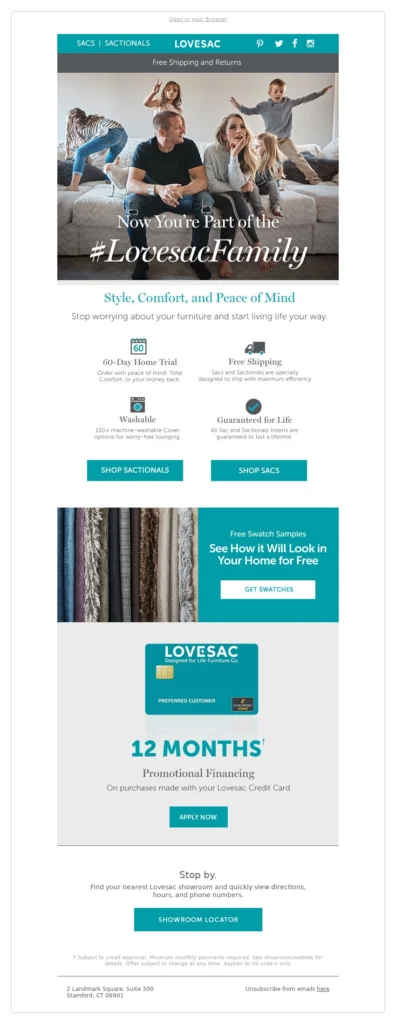

The furniture company Lovesac’s welcome sequence comprises three welcome emails.The first email incorporates a welcome message, the benefits of ordering from Lovesac, and the Lovesac credit card.
Email number two puts the spotlight on two of the brand’s bestsellers — no fluff, just the products people already love. Then the third email flips the script entirely and lets real customers do the talking about why they’re obsessed with their Lovesacs. It’s a smart sequence because it moves from showing you what’s popular to proving it with social proof. This kind of step-by-step flow is a classic trigger email examples approach where each message builds on the last one’s momentum.
It contains user reviews and testimonials while promoting Lovesac’s products in cozy, homey settings. Lovesac’ rewards program is one of the best welcome series email examples.
4. Adidas


In this welcome email series email example, Adidas invites users to complete their profiles to send them customized recommendations and event invitation templates.
Adidas also conveys a limited-time 15% savings offer that’s promoted throughout all three welcome emails.
The second email was sent 5 days after the newsletter signup. What we love is that Adidas keeps it brief, sweet, and to the point while emphasizing its custom coupon code.
By keeping the email brief, subscribers have their attention focused on the two major CTAs. Adidas’ rewards program is one of the best welcome series email examples.
5. Wynd
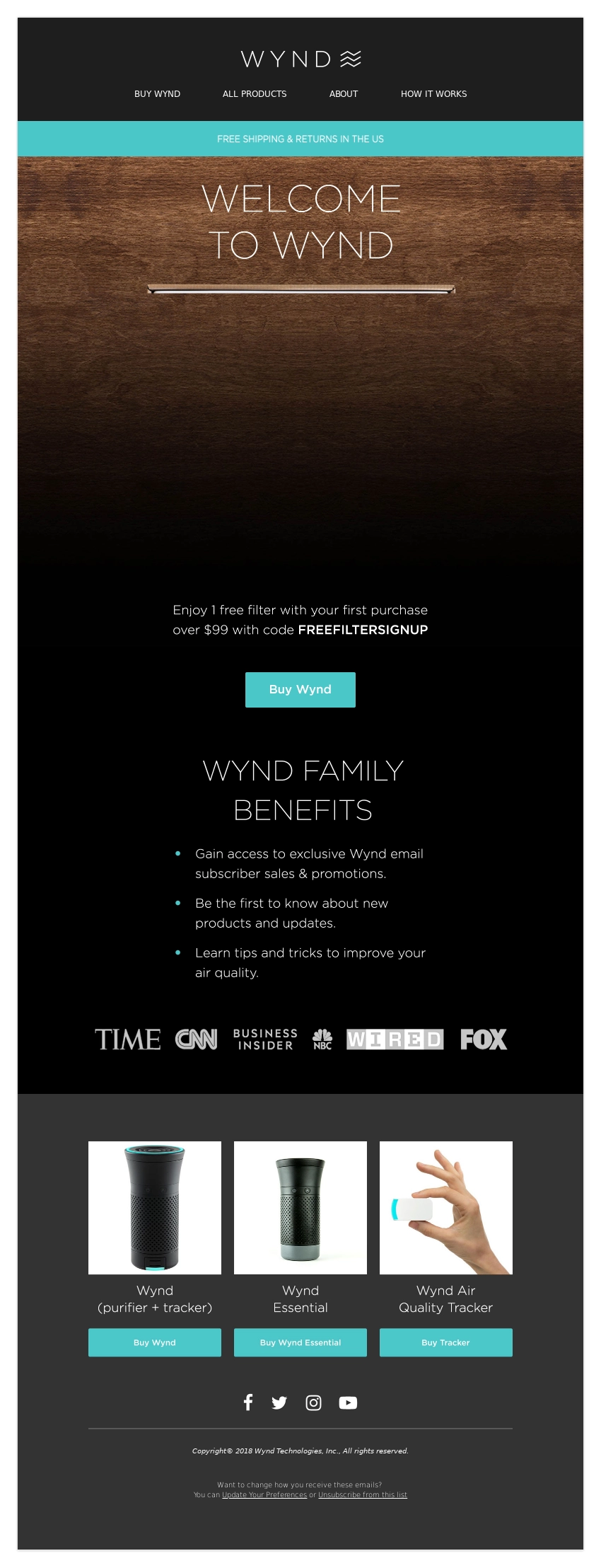

Air purifier Wynd has a brief three-email welcome sequence sent for three days.
In the first email, the brand presents subscribers with a free filter with their first purchase of $99 or more and reminds them of the advantages they appreciate as a subscriber.
The second email concentrates completely on product details and what makes Wynd’s purifiers unique. It also emphasizes other advantages of shopping with Wynd, such as free shipping, a 30-day money-back guarantee, prompt customer service, and the brand’s dedication to assisting local communities.
The third and final email showcases a letter from the co-founder of Wynd emphasizing the company’s mission to help people understand the significance of air quality and
the effect of air quality on health. The letter is followed by real customer reviews driving home the product’s value and usefulness. Wynd’ rewards program is one of the best welcome series email examples.
6. Rent the Runway
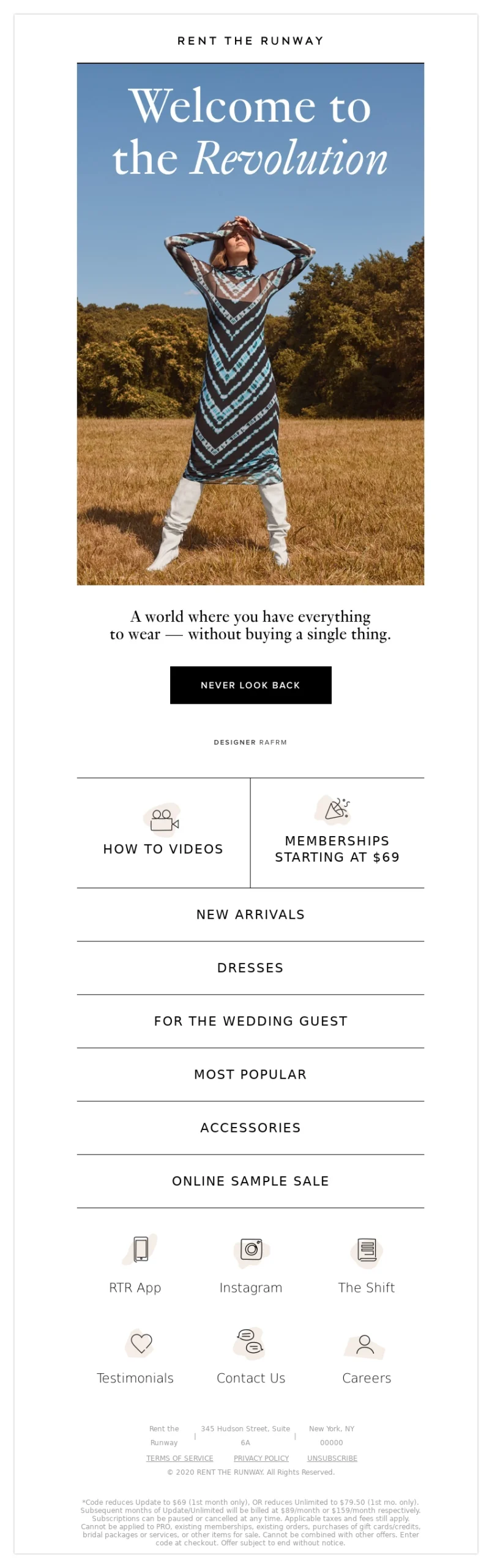
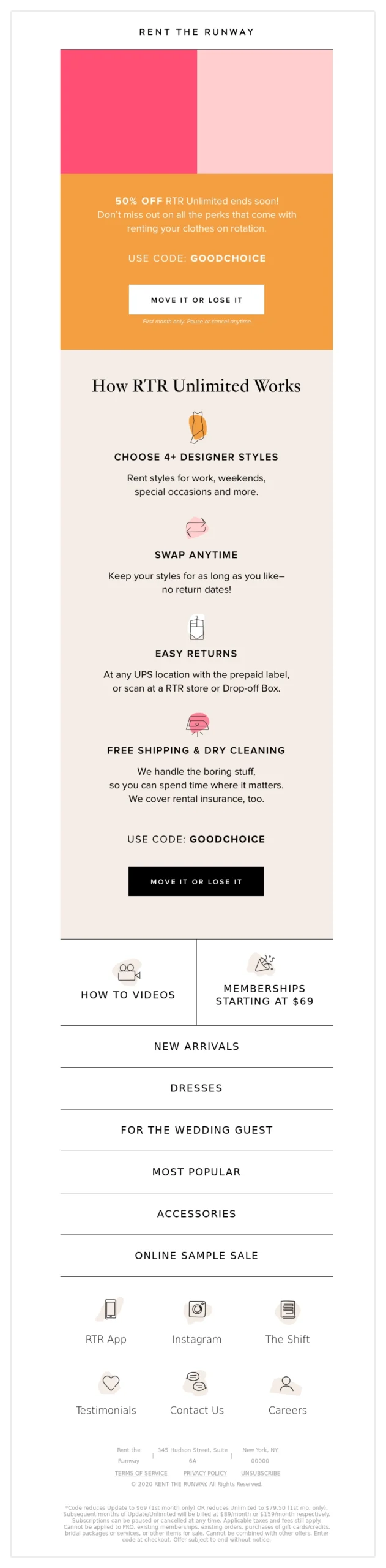
Rent the Runway encourages new subscribers with a four-email welcome series email example.
In the first email, they keep things easy and to the point by welcoming the new subscriber with a fashion photo and a clear black-on-white CTA button to purchase.
In the second email, Rent the Runway promotes its Unlimited RTR program with a 50% discount, conveying urgency. The second half of the email includes how the unlimited program works, including the number of pieces subscribers can pick at a time, changing styles, easy returns, and free shipping.
They continue to promote this discount and reasons to select Rent the Runway in addition to a ‘Renting 101’ video.
All of their emails contain how-to video links toward the bottom of the email and quick links to products, the app, and testimonials. Rent the runway’ rewards program is one of the best welcome series email examples.
7. Sugarfina
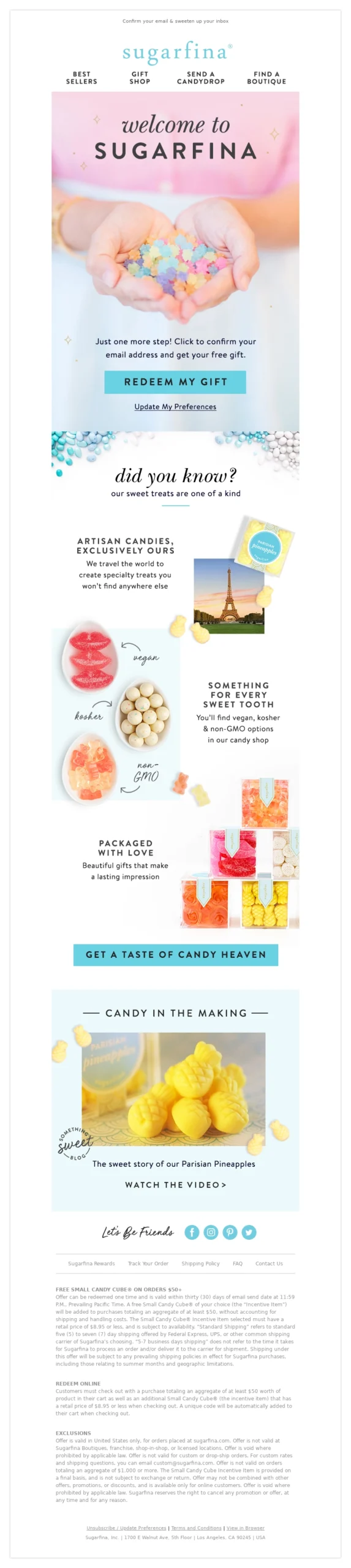

Candy store Sugarfina includes a two-email welcome sequence that shows subscribers a complimentary treat and shares information about their products with a behind-the-scenes video of how some of their candy is made. This is a fantastic way to engage shoppers with the brand and provide them with a VIP experience.
The second email reminds subscribers to redeem their free treat as the offer is expiring soon. It emphasizes its elegant ingredients and boutiques for a truly high-end candy shopping experience.
This email also prompts users to buy at their in-store locations and features a variety of animations throughout the email to bring the fun, upbeat brand to life. Sugarfina’ rewards program is one of the best welcome series email examples.
8. Sephora
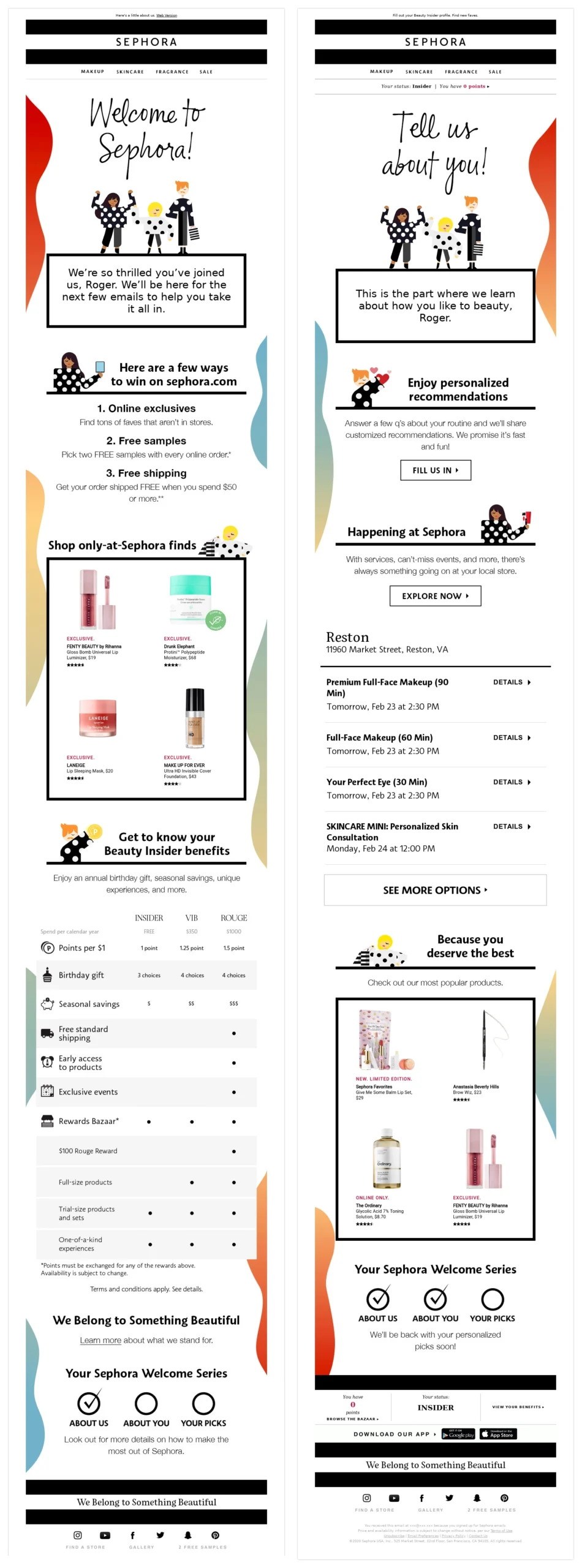
Sephora’ rewards program is one of the best welcome series email examples. The first email in Sephora’s welcome series utilizes first-name personalization in the subject line to speak straight to recipients and draw them to open it.
This email also lists the advantages of shopping online at Sephora, becoming part of the brand’s rewards program, and uncovering exclusive products available only at their stores.
What we love is that they included a note at the bottom of their welcome series emails to offer readers a taste of what’s to come.
There are two remaining emails in this welcome series email example where Sephora concentrates on in-store events, contains a questionnaire to get a better idea of subscribers’ beauty requirements, and invites them to check out popular products.
9. Birchbox
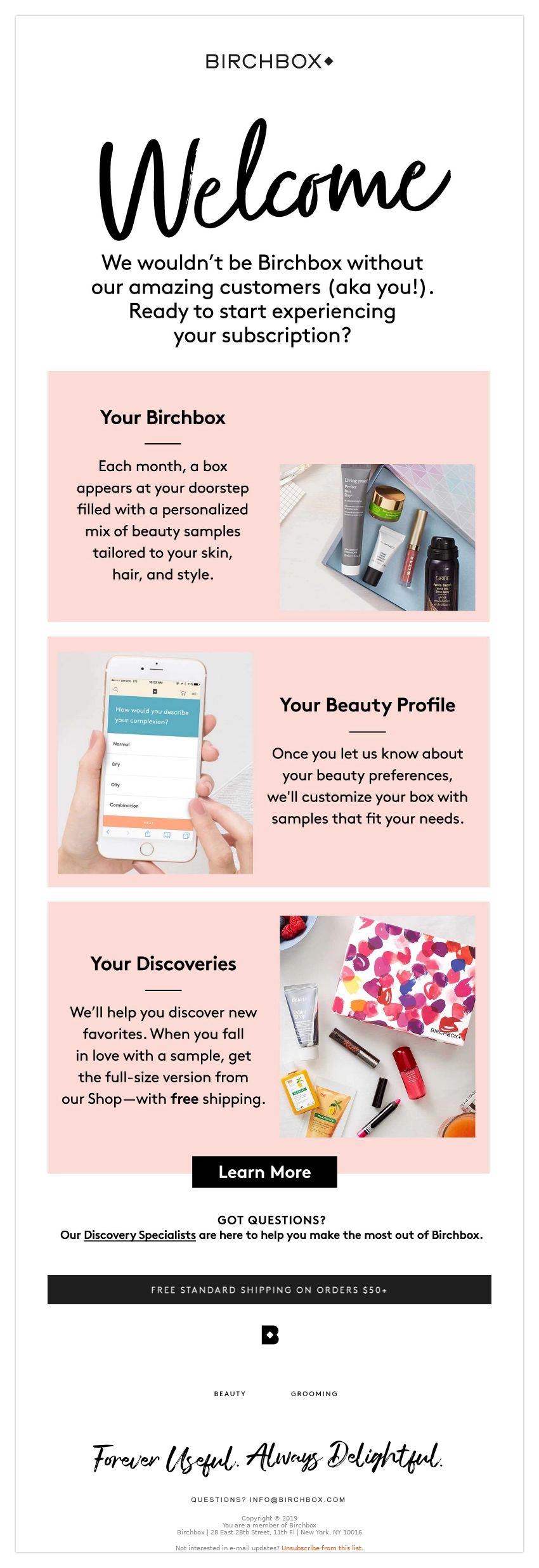

Birchbox, a beauty subscription box, utilizes big cursive headings to make its welcome series emails effective. The four emails in this email sequence all have a theme, with the first giving new subscribers an overview of what their subscription entails. The remaining three emails are sent over the next 7 days to new subscribers.
The second email suggests to customers how they can get the most out of their subscription, while the third presents them to the shop and the loyalty program. It also shows them 15% off to start shopping now.
The fourth and final email of the welcome series asks users to join and engage with the brand by following them on social media, reading their magazine, and downloading the app. We love this technique as it encounters the users past their products page and interacting on social media. Birchbox’ rewards program is one of the best welcome series email examples.
15 More Welcome Series Email Examples Worth Studying
The 9 examples above are heavy on ecommerce and lifestyle brands. The next 15 broaden the field across SaaS, travel, wellness, education, and B2B so you can see how the welcome series adapts across categories.
10. Airbnb
Airbnb’s welcome series for new sign-ups runs three emails over the first week. Email 1 is a clean welcome with a single CTA to start exploring stays. Email 2 lands on Day 2 with destination inspiration based on the user’s location, often featuring stays under $100. Email 3 introduces the host community with a story-led format. The pattern Airbnb nails: zero hard-sell. The brand trusts that the right destination at the right moment converts itself.
11. Headspace
The meditation app sends a 5-email welcome flow over 14 days, designed around habit formation rather than promotion. Email 1 welcomes the user and points them to a 3-minute starter meditation. Email 2 (Day 2) introduces the basics. Email 3 (Day 4) shares user testimonials about sleep and stress benefits. Email 4 (Day 7) offers the free trial extension. Email 5 (Day 14) is a reflection email asking how the first two weeks felt. What works: each email is short, calming, and reinforces a single behaviour.
12. Duolingo
Duolingo’s welcome series leans on personality. Email 1 introduces the green owl mascot, the user’s chosen language, and a single 5-minute first-lesson CTA. Email 2 lands the next day if the user hasn’t logged back in, with a (gently guilt-inducing) “Duo is sad you haven’t practiced.” Email 3 celebrates the first streak. The lesson here: when your product depends on daily habit, your welcome series is also a re-engagement series. The brand voice carries through every email.
13. Glossier
Glossier’s welcome flow is 3 emails over a week, designed to reinforce community over discount. Email 1 is a personal note from the founder, no CTA except a soft “browse the shop.” Email 2 features bestsellers based on category preference. Email 3 introduces the loyalty program and rewards. The brand resists the typical “10% off” first-email tactic in favour of brand storytelling, and the conversion data backs them up — first-purchase rates are reportedly 2x category average.
14. Allbirds
Allbirds runs a 4-email welcome series anchored on sustainability, not discount. Email 1 introduces the brand’s natural materials story (merino wool, eucalyptus tree fibre). Email 2 features the bestselling Wool Runner with size guidance. Email 3 shares customer reviews and the 30-day comfort guarantee. Email 4 introduces sock and accessory cross-sells. The takeaway: a values-led welcome series can outperform discount-led series for premium-priced DTC brands.
15. Casper
Casper’s welcome series runs 5 emails over 21 days because mattresses are a high-consideration purchase that needs longer nurture. Email 1 welcomes and offers $100 off. Email 2 explains the 100-night trial. Email 3 features sleep-science content. Email 4 shows customer reviews and Trustpilot ratings. Email 5 lands at Day 21 with a soft urgency push on the discount expiring. The structure works because each email reduces a different friction point in the buying decision.
16. Warby Parker
Warby Parker’s welcome flow centres on the Home Try-On programme — 5 frames shipped free for 5 days. Email 1 explains how try-on works. Email 2 (Day 2) features bestselling frames by face shape. Email 3 (Day 4) features customer photos wearing the frames. Email 4 (Day 7) introduces the prescription lens upgrade. The brand turns a complex purchase (eyewear with prescription) into a no-risk trial, and the welcome series mirrors that low-friction promise.
17. Brooklinen
Brooklinen’s 4-email welcome series leans on education plus one strong offer. Email 1 introduces the brand and offers 10% off. Email 2 explains thread count and weave types in plain language (the “what’s the difference” question new buyers always have). Email 3 features the Classic Core Sheet Set with reviews. Email 4 brings urgency on the discount expiring. The instructional second email outperforms most competitor flows because it removes a real customer hesitation.
18. Asana
Asana’s SaaS welcome series runs 7 emails over 30 days, all focused on activation. Email 1 walks through creating the first project. Email 2 prompts inviting a teammate. Email 3 introduces task assignments. Email 4 (Week 2) covers automations. Email 5 shares customer success stories. Email 6 introduces premium features. Email 7 (Day 30) summarizes usage and prompts upgrade. Each email has one job: get the user to take one specific action that increases retention. SaaS welcome flows live or die on activation metrics, not opens.
19. Notion
Notion’s welcome series runs 5 emails over 14 days and leans heavily on templates. Email 1 introduces the workspace concept with a “duplicate this template” CTA for a starter setup. Email 2 features 10 popular templates by use case. Email 3 introduces databases. Email 4 features customer stories from notable companies. Email 5 prompts paid plan upgrade for teams. The template-first approach works because Notion’s value is hard to explain abstractly but obvious once you see a working example.
20. Canva
Canva’s welcome series runs 6 emails over 21 days. Email 1 introduces the editor with a “design your first thing in 60 seconds” CTA. Email 2 features design templates by use case (social, presentations, posters). Email 3 introduces brand kits. Email 4 covers Pro features. Email 5 shares creator success stories. Email 6 offers a Pro trial. What works: each email feels like a discovery moment, not a sales push, and the templates do the conversion work.
21. Mailchimp
Mailchimp’s welcome series for new accounts runs 5 emails focused entirely on getting the first campaign sent. Email 1 walks through audience setup. Email 2 covers campaign building. Email 3 introduces automation. Email 4 covers reporting. Email 5 features case studies. Mailchimp treats activation as the only metric that matters during the first 14 days, and the welcome series reflects that. There’s no upsell push until the user has actually sent something.
22. Spotify
Spotify’s welcome series for new free-tier users runs 4 emails. Email 1 confirms account creation and invites to import existing music. Email 2 introduces personalized playlists (Discover Weekly, Daily Mix). Email 3 features podcast discovery based on listening history. Email 4 offers a Premium trial after 2 weeks once the user is engaged. The pattern: don’t ask for the upgrade until the product has demonstrated its value through personalization.
23. Patagonia
Patagonia’s welcome series is unusual: 3 emails, no discount, heavy on environmental mission. Email 1 explains the 1% for the Planet pledge. Email 2 introduces the Worn Wear repair programme. Email 3 features the bestselling jacket categories. The brand essentially says: “if you want a coupon, this isn’t the brand for you.” That filtering effect attracts a higher-LTV customer base, and the welcome series sets the expectation deliberately.
24. Slack
Slack’s welcome series for new workspace admins runs 6 emails over 30 days. Email 1 prompts inviting the first 5 teammates. Email 2 covers channel structure. Email 3 introduces integrations. Email 4 covers search and notifications. Email 5 shares enterprise features. Email 6 offers paid plan trial. Slack’s welcome flow is famously well-tested — almost every email has been A/B optimized over a decade, and the resulting flow is one of the most copied templates in B2B SaaS.
12+ Welcome Email Subject Lines That Convert
The subject line is the difference between an open and a swipe. Welcome emails see the highest open rates of any email type (50-86% on Email 1 according to Mailchimp benchmarks), but only when the subject line earns the open. Here are 12 patterns that consistently outperform, organized by approach:
Warm Welcome (4)
- Welcome to [Brand], [Name]
- [Name], you’re in. Here’s what’s next.
- Hi [Name] — glad you’re here
- Welcome aboard, [Name]
Value-First (4)
- Your 15% welcome discount inside, [Name]
- A small welcome gift for you
- Here’s $10 to start, [Name]
- Welcome — your first order ships free
Curiosity-Driven (4)
- The 3 things every [Brand] customer wishes they knew
- What to do first (it takes 60 seconds)
- Hi [Name] — a quick story before you shop
- Why we started [Brand] (2-min read)
One quick rule: avoid mystery subject lines like “Hey, can I tell you something?” or “You won’t believe this.” Welcome email open rates depend on trust, and curiosity gaps that don’t pay off destroy that trust on the first email.
Email-by-Email Breakdown of a 5-Email Welcome Series
The 24 examples above show what good welcome series look like in the wild. This section walks through what each email should actually do — purpose, timing, subject line, body, CTA, and what to measure. This is the template most ecommerce and DTC brands run, and it’s a strong default starting point.
Email 1 — Welcome (Day 0, sent within 5 minutes of signup)
- Purpose: Confirm signup, deliver promised value (often a discount), set expectations.
- Subject line example: “Welcome to [Brand], [Name] — your 15% off is inside”
- Body essentials: Personal greeting, brand intro (2 sentences max), the discount code, a single primary CTA.
- Primary CTA: “Shop with 15% off”
- What to measure: Open rate (target: 60%+), CTR (target: 8%+), discount-code-redemption rate.
Email 2 — Brand Story (Day 2)
- Purpose: Build emotional connection, differentiate from competitors, soft-sell.
- Subject line example: “Why we started [Brand] (2-min read)”
- Body essentials: Founder note in plain language, 1-2 paragraphs, the customer problem you solve, no CTA pressure.
- Primary CTA: “Browse the collection” (low-pressure)
- What to measure: Open rate (target: 45%+), reply rate (a real signal of brand connection).
Email 3 — Best Sellers / Value (Day 4)
- Purpose: Show the highest-converting products, reduce decision fatigue.
- Subject line example: “What our customers can’t stop buying”
- Body essentials: 4-6 bestsellers with images, ratings (if 4.5+ stars), prices, a “shop all” link at the bottom.
- Primary CTA: Product images themselves act as CTAs
- What to measure: Open rate (target: 40%+), product-page click-through (target: 12%+), revenue per email.
Email 4 — Social Proof (Day 7)
- Purpose: Reduce purchase hesitation, especially for higher-priced or new-buyer-skeptical categories.
- Subject line example: “What 50,000+ customers are saying”
- Body essentials: 3-5 customer reviews with names and star ratings, optional press mentions, optional UGC photos.
- Primary CTA: “Read all reviews” or “Shop top-rated”
- What to measure: CTR, downstream conversion lift on product pages reached from this email.
Email 5 — Urgency / Last Call (Day 10)
- Purpose: Recover non-converters with a deadline-driven last push.
- Subject line example: “Last chance — 15% off ends tomorrow”
- Body essentials: Discount reminder, expiration date in plain text, one last bestseller image, simple CTA.
- Primary CTA: “Use my code”
- What to measure: Conversion rate of subscribers who hadn’t bought from Emails 1-4 — this is the email’s only real job.
One important note: these timings are starting points, not commandments. Your audience’s behaviour data will tell you if Day 4 should be Day 3, or if Email 4 should swap with Email 3. Test it. The structure works; the exact timing is yours to optimize.
Industry-Specific Welcome Series Patterns
The 5-email template above works for most ecommerce. But what works for SaaS, B2B, and publishers looks different. Here’s how the welcome series adapts across four common verticals:
Ecommerce
Ecommerce welcome series are conversion-focused. The 5-email pattern (welcome + offer → brand story → bestsellers → social proof → urgency) is the default starting point. Average first-purchase rates run 8-15% across the full flow, with the discount-led Email 1 driving 60-70% of that conversion. Brand-led brands (Glossier, Patagonia) sometimes outperform discount-led brands on LTV even when initial conversion is lower.
SaaS & Apps
SaaS welcome series are activation-focused. Each email targets a specific in-product action (create your first project, invite a teammate, set up integrations). The flow runs longer (5-7 emails over 14-30 days) because the goal is habit formation, not single conversion. The metric that matters is “users who reached the activation milestone within 14 days” — opens are vanity here.
B2B Services
B2B welcome series are nurture-focused. They run longer (7-10 emails over 30-60 days) and lean on educational content rather than promotion. Email 1 confirms the signup with a thank-you. Emails 2-4 share gated reports, case studies, or webinar invitations. Emails 5-8 introduce specific solutions tied to industry pain points. Email 9-10 invite to a sales call. Average sales-call booking rates run 1-4% of the welcomed list — much lower than ecommerce conversion, but the deal sizes are correspondingly higher.
Newsletters & Publishers
Newsletter welcome series are retention-focused. They run shorter (3-4 emails) and focus on getting the reader to open the second issue, then the third. Email 1 welcomes and shares 3-5 of the most popular past pieces. Email 2 introduces the editorial team or beat. Email 3 invites readers to reply with what they want to read about. Sustaining 40%+ open rates past Email 5 is the real success metric, not first-purchase or activation.
Welcome Email Open Rate Benchmarks (2026)
Welcome emails consistently outperform every other email type because the recipient is expecting them and just opted in. Here are the benchmark numbers email vendors report for 2026:
| Email Type | Avg Open Rate | Source & Notes |
|---|---|---|
| Promotional / Marketing Email | 15-22% | Mailchimp 2025 industry benchmarks (cross-vertical avg) |
| Welcome Email 1 | 50-86% | Klaviyo & HubSpot — highest-opened email type, period |
| Welcome Email 2 (Day 2) | 40-55% | Drop reflects natural engagement decay |
| Welcome Email 3 (Day 4) | 35-45% | Healthy if above 30% |
| Welcome Email 4-5 (Day 7-10) | 25-40% | Re-engagement starts to matter at this point |
| SaaS Onboarding Email Series | 30-50% | Activation emails outperform promotional follow-ups |
The takeaway: if your welcome email open rate is below 40%, you have a deliverability problem, not a content problem. Run an SPF/DKIM/DMARC audit on your sending domain before rewriting the subject line.
Welcome Series Send Timing & Frequency
The exact timing of your welcome series matters almost as much as the content. Send too fast and the user feels overwhelmed. Send too slow and they forget they signed up. Here’s the practical guidance:
Email 1: Within 5 minutes of signup
Email 1 should be a triggered transactional send, not a scheduled marketing send. Anything slower than 5 minutes feels broken to the user, and 60+% of subscribers expect the discount code immediately. If you can’t deliver Email 1 in real-time, fix the trigger setup before optimizing anything else.
Day-of-week considerations
Tuesday-Thursday between 10am and 2pm in the recipient’s timezone are the highest-engagement windows for B2C welcome emails. Avoid Saturday afternoons and Sunday evenings unless your data specifically shows otherwise. For B2B, weekday mornings (8-10am) outperform afternoons.
How long should the gap between emails be?
The standard pattern: Day 0 → Day 2 → Day 4 → Day 7 → Day 10. Gaps shorter than 24 hours feel pushy. Gaps longer than 5 days break the momentum and the user forgets the brand entirely. Adjust by 1-2 days based on category, but the rough cadence holds across most verticals.
Quiet hours
Don’t send between 10pm and 6am in the recipient’s timezone unless the email is genuinely time-sensitive (security alert, expiring offer with hours left). Late-night sends correlate with higher unsubscribe rates and lower next-email engagement.
5 Common Welcome Series Mistakes to Avoid
- The series runs too long. A 10-email welcome series for a $20 product feels like harassment. Match length to consideration depth, not aspiration.
- The first email is purely promotional. Email 1 should deliver value (welcome + promised discount), not pitch. Save the upsell for Email 3 onwards.
- No clear value proposition. If a new subscriber can’t tell what your brand actually does after Email 2, they’re not converting. The brand-story email exists to fix this.
- Missing personalization. Using “Hi friend” instead of “Hi Sarah” cuts open rates 10-25%. Even a default fallback like “Hi there” beats no personalization.
- Broken send timing. Email 1 lands 4 hours after signup. Email 2 lands 8 days later. Email 5 lands 24 hours after Email 4. Inconsistent timing is the most fixable problem on this list and the most commonly broken.
How to Set Up Your Welcome Series in Nvecta
If you’re moving from manual sends to automation, here’s the practical 5-step setup most teams follow. The same flow works in any major email platform — the screens look different but the logic is the same:
1. Define the trigger event
The trigger is what kicks off the series — usually a form submission, account creation, or first purchase. Pick the trigger first because it determines what data you have to personalize with.
2. Set up your audience segments
One welcome series for everyone is a starting point, but better results come from 2-3 segments. Common splits: source (paid vs organic), category interest (clothing vs accessories), or first-purchase amount (under $50 vs over $50).
3. Build your email sequence
Use the 5-email template above as the starting point. Replace placeholder fields with merge tags from your platform. Test fallbacks (what happens if {{first_name}} is missing).
4. Add send-time optimization
Most modern platforms include AI-driven send-time optimization that learns each user’s individual peak engagement window. Turn this on for Emails 2-5. Email 1 should always be triggered immediately.
5. Test and iterate
Send the full sequence to yourself first. Open in Gmail, Outlook, and Apple Mail. Check mobile rendering. Once live, A/B test subject lines on Email 1 (the highest-volume test you’ll run), then move to body content tests.
Nvecta’s email automation suite handles all of this end-to-end with templates, deliverability infrastructure, and analytics built in. For broader strategy, see our guides on email sequences and best email marketing platforms.
Conclusion
After reading the best welcome series email examples you may have understood that welcome emails are an essential part of your marketing strategy. They are a great way to show the world that you care about their experience with your company and that you are there for them, no matter what.
A good welcome email can be the difference between someone coming back for more, staying with you for life, or just giving you a quick look before moving onto their next experience with your brand. All apps mentioned this blog rewards program are bulk of the best welcome series email examples.
Nvecta offers a welcome email series that can help you get started and also help you onboard customers with ease. Start sending welcome emails today.
Frequently Asked Questions
Frequently Asked Questions
1. What is a welcome email series?
A welcome email series is an automated sequence of 3-7 emails sent to new subscribers or customers after they sign up. The first email arrives within minutes of signup and confirms the action plus delivers any promised value (discount, free download).
Subsequent emails introduce the brand, showcase products, build social proof, and drive the first purchase or activation.
2. How long should a welcome email series be?
Most ecommerce welcome series run 3-5 emails over 7-14 days. SaaS and B2B series run longer (5-7 emails over 14-30 days) because the buying decision is more complex.
The key rule: match length to consideration depth. A 10-email series for a low-cost impulse purchase feels exhausting; 3 emails for a B2B SaaS sale leaves money on the table.
3. What should the first welcome email include?
The first welcome email should arrive within 5 minutes of signup and include:
- A personalised greeting
- A brief brand intro
- The promised value (discount code, free download, etc.)
- One clear primary CTA
- Brand sign-off
Skip the lengthy story or 5+ buttons — Email 1’s only job is to deliver value and get the next click.
4. What are average open rates for welcome emails?
Welcome emails see the highest open rates of any email type:
- Email 1: 50-86% (per Klaviyo and HubSpot benchmarks)
- Email 2 (Day 2): 40-55%
- Email 5 (Day 10): 25-40%
If your Email 1 open rate is below 40%, you likely have a deliverability problem (missing SPF/DKIM/DMARC), not a subject line problem.
5. What’s the ideal welcome email series length by industry?
- Ecommerce: 3-5 emails over 7-14 days
- SaaS: 5-7 emails over 14-30 days, focused on activation milestones
- B2B services: 7-10 emails over 30-60 days, leaning on educational content
- Newsletters: 3-4 emails focused on retention, not conversion
Match length to how complex the buying or activation decision is.
6. What makes a good welcome email subject line?
The best welcome email subject lines are short (under 50 characters), personalised with the recipient’s first name, and either lead with welcome or value:
- “Welcome to [Brand], Sarah”
- “Your 15% off is inside”
Avoid mystery or curiosity-gap subject lines on welcome emails — they can hurt long-term trust because the recipient just opted in and expects clarity, not games.
7. What’s the difference between a welcome series and a drip campaign?
A welcome series is a specific type of drip campaign triggered by a new signup or first purchase. Drip campaigns is the broader category — any automated sequence triggered by user behaviour.
Welcome series specifically run on the signup trigger and focus on first-purchase or activation. Other drip campaigns include cart abandonment, re-engagement, post-purchase, and seasonal flows.
8. When should the first welcome email be sent?
The first welcome email should be triggered automatically and arrive within 5 minutes of signup. Anything slower than that feels broken to the user, and over 60% of subscribers expect the welcome discount code immediately.
If your platform can’t deliver Email 1 in real-time, fix that trigger setup before optimizing any other part of the series.
9. What’s a typical 5-email ecommerce welcome series?
The standard 5-email ecommerce welcome series works for most brands:
- Email 1 (Day 0): Welcome + 15% off
- Email 2 (Day 2): Brand story
- Email 3 (Day 4): Bestsellers
- Email 4 (Day 7): Social proof / customer reviews
- Email 5 (Day 10): Urgency / discount expiring
Average first-purchase rates run 8-15% across the full flow when executed well.
10. How should SaaS welcome series differ from ecommerce?
SaaS welcome series should focus on activation, not promotion. Each email targets one specific in-product action: create your first project, invite a teammate, set up integrations, complete onboarding.
Run 5-7 emails over 14-30 days. The metric that matters is “users who reached the activation milestone within 14 days,” not opens. Asana, Notion, and Slack all run variants of this pattern.
11. How do I personalize a welcome email?
Personalize a welcome email at three levels:
- Merge tags in the subject line and body (first name, company, signup source)
- Segmentation by signup source (paid traffic gets a different flow than organic)
- Dynamic content blocks based on category interest or browsing behaviour before signup
Always include a fallback value for missing fields — “Hi there” beats “Hi ,” every time.
12. What are the best practices for a welcome email series?
The 7 highest-impact best practices:
- Trigger Email 1 within 5 minutes of signup
- Personalize with first name and segmentation
- Keep the first email focused on welcome + promised value; save promotion for later emails
- Use one primary CTA per email
- Front-load social proof in Email 4
- Test send timing to find your audience’s peak engagement window
- Set up SPF/DKIM/DMARC on your sending domain so the welcome email actually reaches the inbox
Also Read:
