














 Email
Email SMS
SMS Whatsapp
 Web Push
 App Push
 Audience Sync for Ads
 Popups
 Channel A/B Testing
  Control groups Analysis
 Frequency Capping
 Funnel Analysis
 Cohort Analysis
 RFM Analysis
 Signup Forms
 Surveys
 NPS
NPS Landing pages personalization
  Website A/B Testing
  PWA/TWA
 Heatmaps
 Session Recording
 Wix
Wix Shopify
 Magento
 Woocommerce
 eCommerce D2C
  Mutual Funds
 Insurance
 Lending
  Recipes
  Knowledgebase
 Developer Docs
 Product Updates
 App Marketplace
 Academy
 Ebooks
 Case Studies
 Blog
Blog Templates
 Aparupa Saha
Businesses invest in customer data platforms expecting something bigger than cleaner reports or centralised customer records. The expectation is usually clear: understand customers better, personalise experiences faster, and create growth opportunities that were difficult to achieve before. Yet many businesses complete deployment and quietly realise that very little has changed.
That is what makes CDP deployment failures difficult to spot. Data starts flowing, dashboards look healthier, and integrations go live. From the outside, everything appears successful. But teams still export spreadsheets, campaigns feel generic, and customer experiences remain disconnected. More customer data does not automatically create better decisions.
The uncomfortable reality is that most CDP deployments do not fail because of the platform itself. They fail because organisations underestimate what happens after implementation. In this blog, we will uncover the hidden failure modes that limit customer data value, explore what successful teams do differently, and look at practical ways to avoid those mistakes. We will further see how NVECTA helps businesses turn customer data into faster activation, connected customer journeys, and measurable business outcomes.
What Causes Most CDP Deployments to Fail?
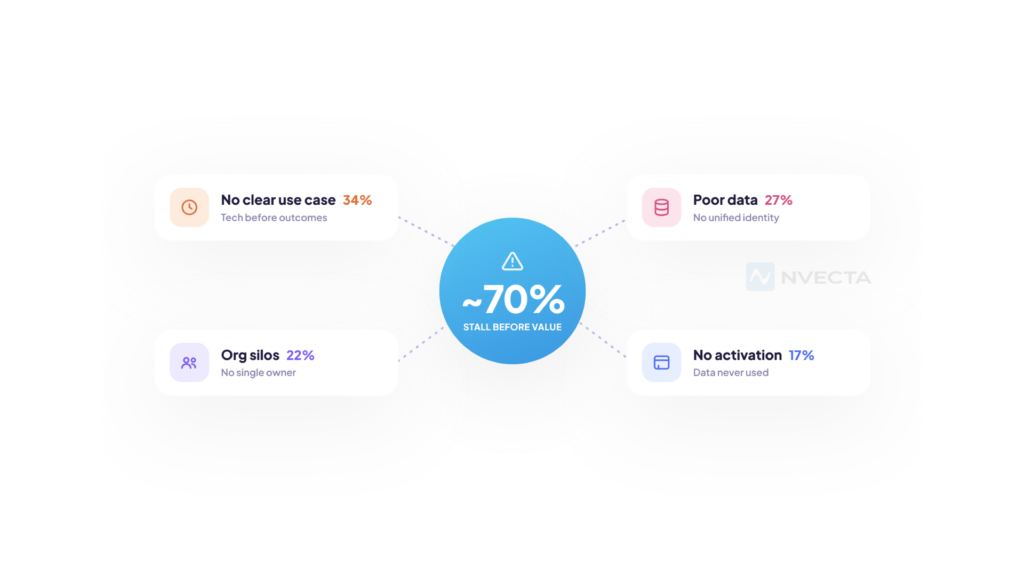
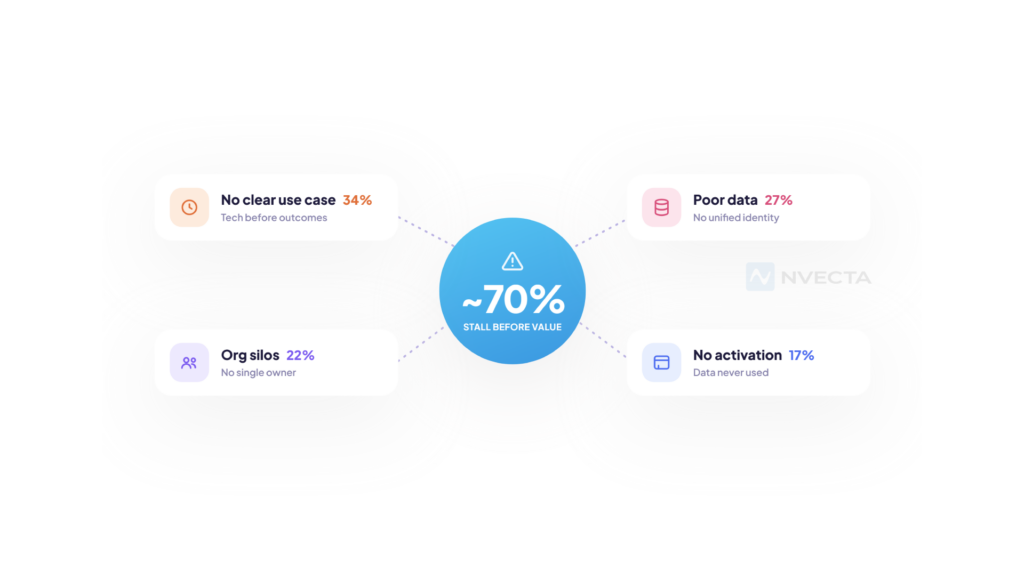
Most CDP deployments do not fail because businesses selected the wrong platform. They fail because implementation gets mistaken for transformation.
Customer data becomes centralised, but activation, ownership, measurement, and customer decision-making often remain unchanged. That gap is where most deployments quietly lose momentum.
1. Starting With Technology Instead of Business Outcomes
Many teams start with platform demos, integration plans, and technical requirements before deciding what should improve for the customer or the business.
The result is familiar: data gets collected, systems get connected, but teams struggle to explain what success actually looks like after launch.
Successful deployments usually answer these questions first:
- Which customer experience should improve?
- Which business metric should move?
- Which decision should become easier?
2. Lack of Clear Customer Data Use Cases
A CDP creates value when it supports a real business outcome, not when it stores more customer information.
Without clear use cases, teams often end up creating audiences, dashboards, and reports that look impressive but rarely change execution. Customer data becomes available, yet customer experiences stay almost identical.
3. Weak Identity Resolution Across Channels
Customers rarely move through one clean journey anymore. Someone may discover a brand through an ad, return through search, engage by email, and purchase later through another channel.
If those interactions remain disconnected, businesses create multiple versions of the same customer. That usually leads to:
- inconsistent personalization
- unreliable reporting
- fragmented customer journeys
Identity resolution may not be the most visible part of deployment, but it often becomes one of the most valuable.
4. Poor Customer Data Quality and Governance
Customer data platforms make customer information easier to access. They do not automatically make it accurate.
If source systems contain duplicates, missing attributes, outdated records, or conflicting definitions, those issues become more visible after deployment.
Over time, teams stop trusting customer intelligence and begin returning to manual processes.
5. Delayed Customer Data Activation
Many deployments spend months collecting and organising customer data while activation stays in the future roadmap.
The problem is simple. Customer value appears only when insights influence action.
That means:
- better audience selection
- more relevant journeys
- faster engagement decisions
- improved customer experiences
Without activation, deployment becomes storage with better reporting.
6. Measuring Implementation Instead of Business Outcomes
Connected systems and growing customer profiles can make deployment look successful, but customers never experience implementation metrics.
The stronger question is: what changed after deployment?
Look for outcomes such as:
- engagement quality
- campaign speed
- retention improvement
- conversion impact
- operational efficiency
Those signals usually tell a more honest story than implementation dashboards.
How to Identify CDP Deployment Failures Before It Impacts Performance
CDP deployments rarely stop delivering value overnight. Most start slowing down quietly while everything still appears healthy on the surface.
Customer data continues flowing, reports remain available, and teams assume the deployment is progressing normally. The early signs usually appear in execution long before they show up in business results.
Recognising those signals early matters because small gaps in adoption and activation tend to grow over time.
1. Customer Segmentation and Personalisation Stop Improving
One of the earliest signs of deployment underperformance appears in the customer engagement platform. Teams gain access to more customer information, yet campaigns begin looking surprisingly familiar.
Segments become larger, audience logic becomes more complex, but communication does not become noticeably more relevant.
This often happens because customer intelligence stays inside planning instead of influencing execution. More customer data should gradually make decisions simpler and customer experiences more precise.
When that improvement stops appearing, the deployment value may not be moving forward.
2. Teams Continue Using Manual Workflows
Customer data platforms are expected to reduce operational effort over time. When teams continue exporting spreadsheets, rebuilding audiences manually, or combining reports outside the platform months after deployment, it usually points to a deeper issue.
The problem is not manual work itself. The concern appears when customer intelligence exists, but daily processes remain unchanged. A successful deployment should slowly reduce operational dependency on workarounds and make execution easier across teams.
3. Customer Data Becomes Harder to Trust
Trust tends to decline quietly before performance does. Teams begin noticing small inconsistencies. Customer counts vary across reports. Audience sizes look unexpected.
Definitions start changing between departments. None of these issues seems serious in isolation, but together they create hesitation.
Once teams stop trusting customer data, they usually return to local files and personal logic. At that point, deployment adoption becomes much harder to recover.
4. Cross-Channel Orchestration Remains Disconnected
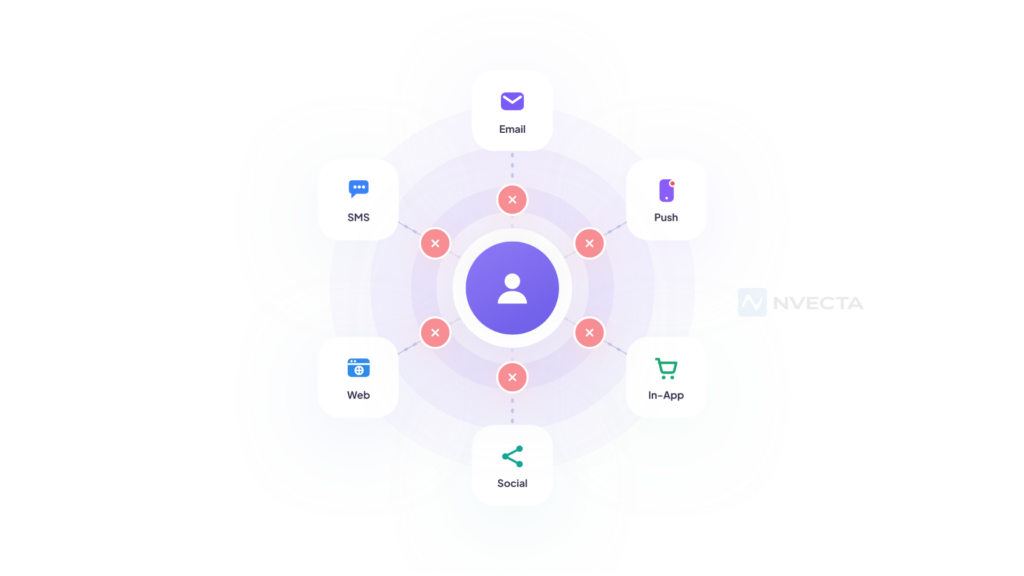
One of the strongest signals of stalled deployment value is when channels continue operating independently despite having access to unified customer information.
Customer behaviour in one channel should gradually improve decisions in another. Engagement should feel more connected over time. When customer journeys remain fragmented after deployment, it often means customer intelligence is being collected but not operationalised.
Customers rarely notice better infrastructure. They notice more relevant experiences.
5. Customer Insights Stay Inside Reporting
Customer data becomes valuable when it changes decisions, not when it generates more visibility.
Many organisations reach a stage where reporting improves dramatically, but customer experiences stay largely unchanged. Teams understand customers better, yet journeys, messaging, and execution continue following familiar patterns.
That gap usually indicates that customer intelligence is informing observation more than action.
6. Business Impact Becomes Difficult to Explain
A practical test is to ask a simple question: what improved because of the deployment?
Strong teams answer quickly. They talk about faster execution, stronger engagement, better retention, or more connected customer journeys.
When teams explain features, integrations, and customer profiles but struggle to describe outcomes, deployment may still be operating below its potential.
How to Avoid CDP Deployment Failures: A Practical Framework
By the time deployment problems become visible, most organisations have already invested significant time, budget, and internal effort. That is why prevention matters more than recovery.
Successful CDP deployments are rarely the result of one perfect decision. They usually come from a series of practical choices that keep customer data connected to business outcomes.
There is no universal deployment model that works for everyone. Still, the strongest teams tend to follow a few patterns that make customer intelligence easier to activate, measure, and improve over time.
1. Define Measurable Use Cases Before Implementation
Many deployment challenges can be avoided before implementation even begins.
Teams often spend time selecting platforms and designing integrations without agreeing on what success should look like. That creates activity, but not always direction.
A stronger starting point is identifying one or two outcomes that should improve within the first phase of deployment. That could be customer retention, engagement quality, conversion efficiency, or campaign execution speed. Clear use cases create boundaries and help customer data stay connected to decisions.
2. Build Customer Data Integration Around Activation Goals
Not every available data source needs to be connected immediately.
One of the most practical decisions successful teams make is choosing integrations based on action, not completeness. If a customer signal does not support journeys, segmentation, engagement, or decision-making in the near term, it may not need to be prioritised early.
This usually creates faster adoption because teams begin using customer intelligence while the deployment continues evolving.
3. Establish Governance and Ownership Early
Customer data becomes difficult to scale when nobody owns how it should be defined, maintained, or activated.
Governance often sounds like a process discussion, but it has a direct impact on execution. Teams move faster when expectations are clear, and customer definitions remain consistent across the organisation.
Ownership should answer simple questions: who manages quality, who approves changes, and who measures outcomes.
4. Measure Success Beyond Implementation Metrics
A deployment can look successful internally while creating very little external impact.
That is why measurement should move beyond profile counts, connected systems, and event volume. Those indicators show progress, but they do not explain whether customer experiences have improved.
Customer outcomes tend to give a clearer picture. Better engagement, faster execution, stronger retention, and more responsive journeys usually reveal whether customer data is creating business value.
5. Optimise Continuously Instead of Treating Deployment as Finished
One of the biggest mindset shifts happens after launch.
Customer behaviour changes constantly. Journeys that worked six months ago may become ineffective later. Audience logic evolves. Activation opportunities expand.
The strongest deployments create space for continuous improvement. Teams review what is working, remove unnecessary complexity, refine customer intelligence, and adapt without rebuilding the entire system.
That approach often creates more value than trying to design the perfect deployment from day one.
A successful CDP deployment is not the point where customer data becomes available. It is the point where customer data starts becoming useful and continues improving over time.
Real CDP Deployment Examples: What Worked and What Failed
Frameworks explain what good deployment looks like. Real outcomes usually depend on how quickly customer data becomes part of execution. These examples reflect a pattern that appears across many CDP initiatives.
Example 1: A Technically Successful Deployment That Failed to Create Business Value
One organisation focused heavily on building a complete customer view before changing customer experiences. Multiple systems were connected, customer profiles became richer, and reporting improved across teams. On paper, deployment looked successful.
A few months later, the business started asking a different question: what actually changed? Campaign execution remained similar, customer journeys evolved slowly, and teams continued relying on familiar workflows. Customer intelligence improved, but decisions did not improve at the same pace.
The deployment struggled because implementation progressed faster than activation.
Example 2: A Smaller Deployment That Created Faster Business Impact
Another business started with one clear objective: to improve repeat customer engagement and reduce campaign delays. The team prioritised only the customer signals that supported those goals and built activation into deployment from the beginning.
Customer intelligence quickly became part of audience decisions and journey execution. Teams adopted the system faster because they could see visible improvements instead of waiting for complete implementation.
The difference was not more customer data. The difference was making customer data useful earlier.
These examples highlight an important pattern. Deployment outcomes are usually shaped less by implementation scale and more by how quickly customer intelligence starts influencing execution.
How NVECTA Supports Effective CDP Deployment
NVECTA approaches CDP deployment with a practical focus on making customer data usable, not just available. The platform supports the areas that commonly slow deployment outcomes, including activation, orchestration, governance, and adoption across teams.
Rather than treating deployment as a one-time implementation exercise, NVECTA helps businesses create a stronger connection between customer intelligence and everyday execution.
1. Build a Unified Customer View Across Channels
NVECTA helps connect customer interactions across channels into a more unified view. This reduces fragmented identities and creates better continuity across journeys, reporting, and customer engagement decisions.
2. Accelerate Customer Data Activation Across Teams
Customer data becomes more useful when teams can act on it quickly. NVECTA supports faster activation by helping customer insights move into segmentation, journeys, and engagement workflows with less operational delay.
3. Improve Cross-Channel Journey Orchestration
Disconnected channels often create inconsistent customer experiences. NVECTA supports journey orchestration across touchpoints so engagement becomes more coordinated and customer interactions feel more connected over time.
4. Enable Real-Time Customer Engagement Decisions
Customer behaviour changes quickly, and delayed action often reduces impact. NVECTA’s AI Decisioning helps teams respond to customer signals sooner, so engagement decisions stay more relevant and timely
5. Strengthen Customer Data Quality and Governance
Reliable customer intelligence depends on consistency and trust. NVECTA supports governance practices that help maintain cleaner customer data and improve confidence across teams using it.
6. Support Smarter Segmentation With AI-Driven Insights
Segmentation becomes difficult when audiences grow more complex. NVECTA helps teams identify more meaningful customer groups and improve relevance without adding unnecessary operational effort.
7. Reduce Operational Dependency Through Automation
Manual workflows can slow activation and limit adoption. NVECTA supports automation across customer engagement processes so teams spend less time managing operations and more time executing.
8. Continuously Optimise Customer Experiences Over Time
Customer expectations and behaviour continue evolving after deployment. NVECTA supports ongoing optimisation so customer engagement strategies can improve without requiring large-scale rebuilding.
Final Thoughts
CDP deployment rarely succeeds because of implementation alone. The real difference appears after launch, when customer data starts influencing decisions, improving execution, and becoming part of everyday customer engagement.
Businesses that create long-term value usually focus less on collecting more data and more on making existing customer intelligence easier to use, measure, and improve over time.
NVECTA supports that approach by helping businesses connect customer intelligence with activation and engagement so deployment efforts continue creating value beyond implementation.
Turn customer data into long-term business value through effective CDP deployment with NVECTA.
Schedule a demo now.
FAQs
What is the biggest reason most CDP deployments fail?
Most CDP deployments fail because implementation gets completed without changing how customer data is used. Customer information becomes centralised, but activation, ownership, customer journeys, and business decisions continue operating the same way as before.
How do you measure whether a CDP deployment is successful?
Successful CDP deployment should be measured through business outcomes, not implementation milestones. Indicators such as customer engagement, campaign speed, retention, journey performance, and operational efficiency usually provide a clearer picture than profile counts or connected systems.
How long does it take for a CDP deployment to create business value?
Deployment timelines vary, but business value often appears faster when organisations begin with clear use cases and early activation. Teams that focus on measurable outcomes and phased execution generally see results sooner than those waiting for complete implementation.
How can businesses avoid common CDP deployment failures?
Businesses can reduce deployment risk by defining customer use cases early, prioritising activation, improving data governance, and measuring outcomes continuously. Keeping customer intelligence connected to execution usually creates stronger long-term deployment success.
How does NVECTA support effective CDP deployment?
NVECTA supports effective CDP deployment by helping businesses unify customer data, accelerate activation, improve journey orchestration, strengthen governance, and enable more connected customer engagement. The focus stays on creating long-term business value beyond implementation.
