














 Email
Email SMS
SMS Whatsapp
 Web Push
 App Push
 Audience Sync for Ads
 Popups
 Channel A/B Testing
  Control groups Analysis
 Frequency Capping
 Funnel Analysis
 Cohort Analysis
 RFM Analysis
 Signup Forms
 Surveys
 NPS
NPS Landing pages personalization
  Website A/B Testing
  PWA/TWA
 Heatmaps
 Session Recording
 Wix
Wix Shopify
 Magento
 Woocommerce
 eCommerce D2C
  Mutual Funds
 Insurance
 Lending
  Recipes
  Knowledgebase
 Developer Docs
 Product Updates
 App Marketplace
 Academy
 Ebooks
 Case Studies
 Blog
Blog Templates
 Aparupa Saha
Quick Answer
Marketing automation KPIs are the metrics that show whether your automated campaigns are generating leads, converting them, and contributing to revenue. The most useful ones span four areas: lead generation, engagement, conversion, and post-sale retention — each tied to a different stage of the customer journey. Tracking all four together is what separates teams that understand their automation from teams that just assume it’s working.
Marketing automation is something most teams depend on now. Automated emails, nurture sequences, and lifecycle campaigns make it possible to manage more leads without adding more manual work. It keeps things running. But it does not automatically mean your marketing is doing what it should.
To figure that out, you need to look at the numbers that matter.
Without KPIs, automation can feel productive while producing very little. Campaigns launch, emails are sent, and workflows run in the background, but it is not always clear what is actually helping the business and what is not.
KPIs help bring that clarity. They show where leads engage, where they drop off, and which efforts contribute to conversions and revenue. They also make it easier to adjust campaigns instead of guessing what needs to change.
This article walks through the marketing automation KPIs worth paying attention to and explains how they connect to lead generation, conversions, and growth. If you are responsible for marketing results, this should help you make better use of your data and avoid flying blind.
Why Marketing Automation KPIs Matter
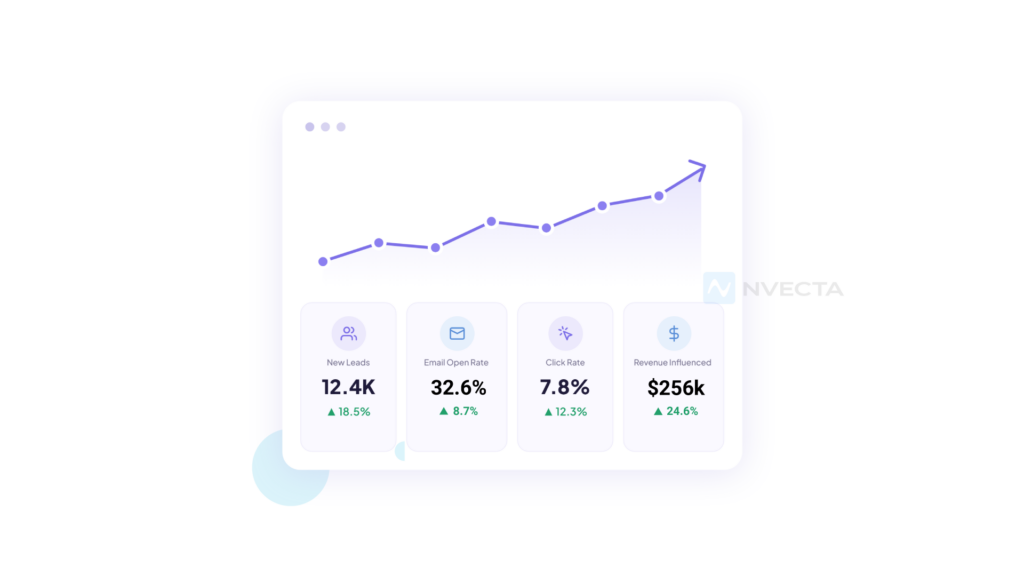
Once marketing automation is up and running, a lot of things happen automatically. Emails send. Workflows fire. Leads move around in the system—all powered by a connected Customer Data Platform that keeps your customer data unified and actionable.
From the outside, it can look like everything is fine. But without KPIs, there is no real way to know what is actually working and what is just noise.
KPIs give you a way to step back and see the full picture. They show how people move from first contact to becoming customers and whether automation is helping or getting in the way.
How KPIs Connect Marketing to the Business
Marketing teams are often judged on activity because it is easy to measure. Campaigns launched. Emails sent. Forms filled. That does not always explain how marketing helps the business grow.
KPIs give everyone a clearer picture. When automation performance is connected to leads and revenue, marketing results are easier to understand.
It also brings marketing and sales closer together since both teams can see what is performing well and what needs attention.
Move Beyond Vanity Metrics
Some metrics feel good to report, but do not say much on their own. Open rates and traffic spikes can look impressive, yet nothing changes downstream.
KPIs help focus attention on what happens next. Are leads converting? Are deals moving forward? Is revenue actually being influenced?
That perspective keeps teams from chasing numbers that look good but do not move the business.
Identify Bottlenecks and Optimisation Opportunities
Automation can quietly fail if no one is paying close attention. A nurture sequence may stop connecting with customers, a sales handoff could break down, or leads might pile up without moving forward. This becomes even more important in Cross-Channel marketing, where businesses rely on smooth communication across email, social media, websites, and ads to keep customer journeys consistent and engaging.
KPIs make those issues visible. They show where people drop off and where momentum slows. With that insight, teams can make small, informed changes instead of guessing or reacting too late.
Core Marketing Automation KPIs to Track
If you want to know whether marketing automation is doing its job, you cannot look at just one stage. Early numbers can look fine while problems show up later.
The KPIs that matter most track what happens from the first interaction through engagement, conversion, revenue, and what comes after the sale. That full view makes it easier to understand how early campaigns connect to real business results.
Looking at performance across the entire funnel also helps surface weak spots. You can see where interest drops off, where leads stop moving, and which efforts actually turn into customers.
That makes it easier to adjust your automation in a way that supports long-term growth instead of short-term wins.
Lead Generation and Acquisition KPIs
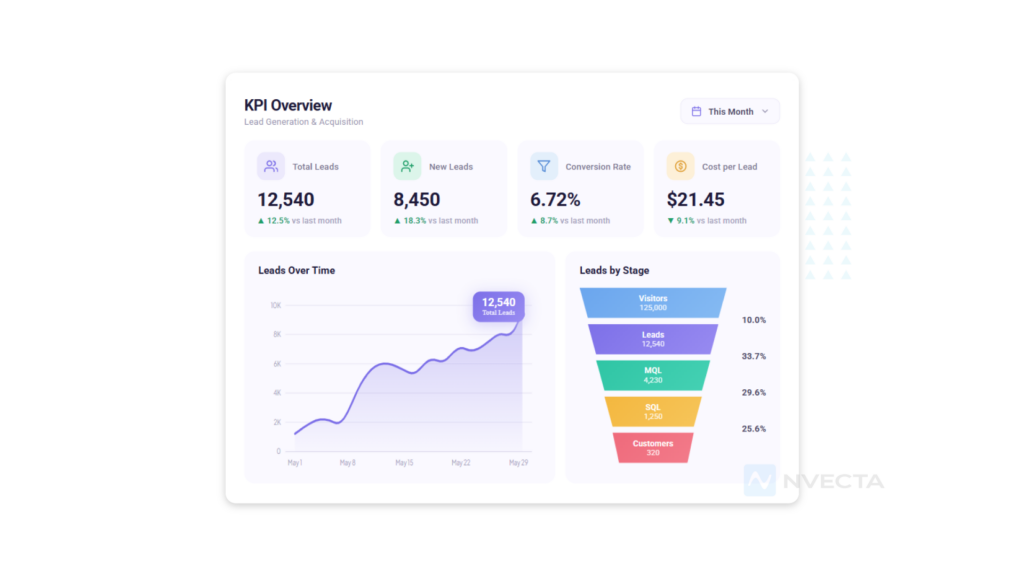
Lead generation and acquisition KPIs help show whether your marketing automation is actually bringing new people in.
These metrics focus on the earliest stage, when someone first comes across your brand. Volume on its own does not mean much, but these KPIs make it easier to see if automation is generating enough interest to support future pipeline and revenue.
1. Number of Leads Generated
This KPI measures how many new leads are captured through automated efforts such as landing pages, gated resources, email sign-up forms, and paid campaigns.
Why it matters:
Lead volume gives you a basic sense of whether your automation is doing its job at the top of the funnel.
If the number drops, it can point to issues with targeting, messaging, or channel mix. It may also signal that offers are no longer resonating with your audience.
While high volume does not guarantee quality, consistent declines usually mean something needs attention.
2. Cost Per Lead (CPL)
Cost per lead is the average amount you spend to get one lead from your automated efforts.
Formula:
Total spend divided by the number of leads
Why it matters:
CPL helps you see if what you are spending makes sense. When it stays low, campaigns are usually doing their job.
When it starts rising, it can point to wasted spend, poor targeting, or channels that are no longer effective. Watching this number over time makes it easier to step in early and adjust.
3. Lead Source Performance
Lead source performance looks at which channels are bringing people in and what happens to those leads after. This could be email, ads, social platforms, search traffic, webinars, or content offers.
Why it matters:
Some channels generate a lot of leads that never move forward. Others may bring in fewer people but with a much higher chance of converting.
Seeing this clearly helps you focus on the sources that deliver real results and scale back on the ones that do not.
Lead Quality and Nurturing KPIs
Getting a lead into the system does not mean much by itself. People sign up, download things, and then disappear all the time. What matters is what happens after that and whether anyone is paying attention.
Marketing automation is meant to handle that follow-up and give some indication of who is still interested. These KPIs help you see if leads are moving anywhere or if they are just sitting in the database untouched.
They also help answer some basic questions. Are people responding to what you send them? Are any of them showing real intent?
Are sales getting leads that are actually worth a conversation? Without looking at this, it is easy to keep generating leads without ever fixing what happens next.
1. Marketing Qualified Leads (MQLs)
MQLs are leads that start to stand out. They engage more, come back, or match your target profile better than the rest.
Why it matters:
This metric helps you tell the difference between curiosity and real intent. It shows whether your nurturing efforts are doing anything useful or simply moving leads along without purpose.
2. Lead to MQL Conversion Rate
This tells you how many leads actually make it past the initial stage and become MQLs.
Formula:
MQLs divided by total leads
Why it matters:
If only a small number of leads reach this point, something is not working. Either the leads are not a good fit or the follow-up is not helping.
When the number starts to improve, it usually means automation is doing a better job of guiding people before sales steps in.
3. Lead Scoring Accuracy
Lead scoring is how you decide which leads are worth paying attention to.
Why it matters:
When high-scoring leads rarely turn into customers, the scoring is off. Good scoring helps sales focus on leads that are more likely to go somewhere instead of wasting time on the wrong ones.
Engagement KPIs
Engagement KPIs help answer a basic question: Are people doing anything with what you send them? Emails and campaigns can run in the background nonstop, but that does not mean anyone is paying attention. These metrics help you see what gets a reaction and what gets ignored.
1. Email Open Rate
This is just how many people open your emails.
Why it matters:
If people are not opening emails, something is wrong early on. The subject line might not be interesting, the sender name might not ring a bell, or the list itself could be stale.
Opens do not tell you if something worked, but they do tell you when something is not working.
2. Click Through Rate (CTR)
CTR shows how often people click once they see your message.
Why it matters:
Clicks usually mean the message landed. People understood it and felt it was worth acting on. When clicks are low, it often means the content is unclear or the offer is easy to ignore.
3. Content Engagement Metrics
These look at what people do after they click, like whether they stay on a page, download something, or show up to an event.
Why it matters:
When people spend time, the content is probably useful to them. When they leave quickly or stop engaging, it is usually a sign that the content is not helping or showing up at the wrong time.
Funnel and Conversion KPIs
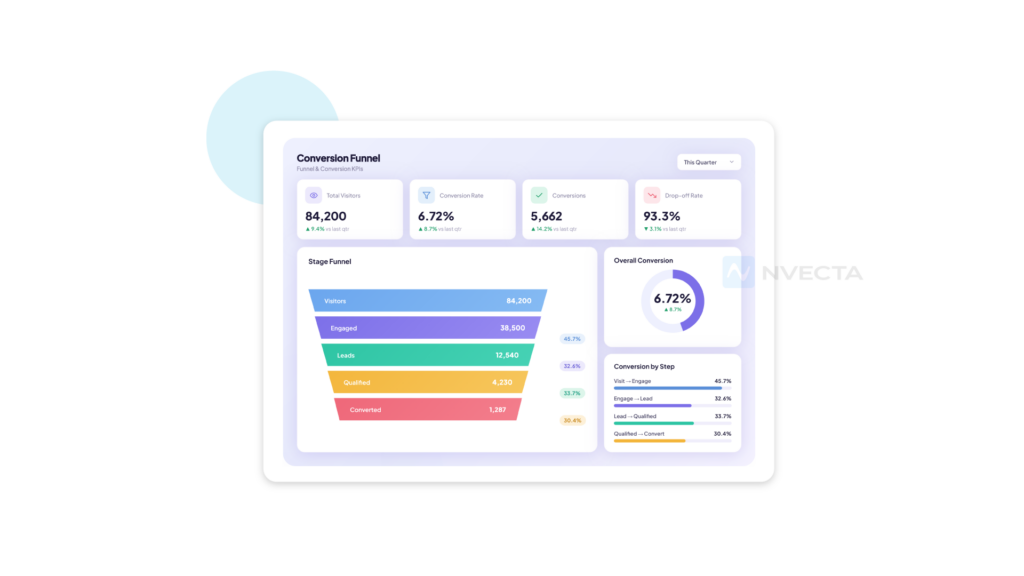
These KPIs are about movement. Leads coming in do not matter much if they never go anywhere.
Funnel and conversion metrics help you see whether automation is actually pushing people forward or just keeping them busy in the system.
1. MQL to SQL Conversion Rate
This shows how many leads marketing passes to sales that sales actually want to talk to.
Why it matters:
When this works, marketing and sales usually agree on what a good lead looks like. When it does not, leads get passed too early, expectations are unclear, or teams are simply out of sync.
2. Conversion Rate by Campaign or Workflow
This looks at whether people take the next step in a specific campaign, like booking a demo or starting a trial.
Why it matters:
Some workflows do a lot of work but deliver very little. Looking at conversions by campaign makes it easier to see what is pulling its weight and what needs fixing or cutting.
3. Sales Cycle Length
This is how long it takes for a lead to turn into a customer.
Why it matters:
Automation should help shorten this, not drag it out. When prospects get the right information early, sales conversations tend to move faster and feel more productive.
Revenue and ROI KPIs
At some point, marketing performance has to tie back to money. Revenue and ROI KPIs help answer the question leadership actually cares about: Is marketing automation worth the investment?
1. Revenue Influenced by Marketing Automation
This looks at how much revenue is connected to automated campaigns, whether marketing started the conversation or helped move it along.
Why it matters:
This metric helps link day-to-day marketing work to real business results. When you can show that automation played a role in closed deals, it becomes much easier to justify spending and defend budget decisions.
2. Customer Acquisition Cost (CAC)
CAC is the total cost of bringing in a new customer, including both marketing and sales efforts.
Why it matters:
One of the goals of automation is to make the process more efficient. Over time, CAC should come down as targeting improves and conversion rates go up.
If CAC keeps rising, it is usually a sign that something needs attention.
3. Return on Marketing Investment (ROMI)
ROMI shows how much return you get for each dollar spent on marketing.
Formula:
Revenue minus marketing cost, divided by marketing cost
Why it matters:
This is one of the clearest ways to judge whether marketing automation is actually paying off. When ROMI is strong, it means automation is not just busy but profitable.
Retention and Lifecycle KPIs
Once someone becomes a customer, that is where a lot of the real work starts. People sign up, buy once, and then drift away all the time.
It usually does not happen all at once. It happens quietly. Retention and lifecycle KPIs help you catch that before it turns into churn you cannot explain.
1. Customer Retention Rate
This is simply how many customers stick around.
Why it matters:
When people leave, it is rarely random. They may not understand the product, they may stop seeing value, or they may feel forgotten. Automation can help with this, but only if it is doing more than sending generic messages.
2. Repeat Purchase Rate
This looks at whether customers come back.
Why it matters:
People only buy again if the first experience was worth it. Repeat purchases usually mean expectations were met and follow-up felt relevant, not pushy.
3. Upsell and Cross-Sell Conversions
This shows whether existing customers buy more over time.
Why it matters:
Selling more to people who already trust you is usually easier than finding new customers. When upsells work, it is often because the timing makes sense and the offer actually fits what the customer needs.
Operational Efficiency KPIs
Operational KPIs are really about one thing: is automation actually making the team’s work easier?
Tools can look impressive, but if day-to-day work still feels heavy, something is off. These KPIs help show whether automation is helping or just adding more steps.
1. Campaign Execution Time
This is how long it takes to go from idea to live campaign.
Why it matters:
Automation should speed things up. If campaigns still take forever to launch, the process probably needs cleaning up. When execution time drops, teams usually get more breathing room to focus on planning instead of busywork.
2. Automation Versus Manual Task Ratio
This looks at how much work is handled automatically versus done by hand.
Why it matters:
If most tasks are still manual, automation is not pulling its weight. A higher automation share usually means the team can handle more work without burning out.
3. Cost Savings From Automation
This compares what things cost before automation and after.
Why it matters:
Savings make automation easier to justify. When costs go down, it shows the tool is doing more than just looking good on a slide. It is actually improving how the team operates.
How to Choose the Right Marketing Automation KPIs
You do not need to track everything. Most of the time, that just makes things harder to read. The right KPIs depend on what the business actually cares about right now and where marketing is supposed to help.
Start with the problem.If leadership is asking about revenue, then revenue-related numbers matter. If the issue is not enough leads, then leads and conversions matter.
If customers keep leaving, then retention and repeat behaviour matter more than anything else. Pick KPIs that answer the question you keep getting asked.
How you sell also matters.
B2B usually moves more slowly. Leads take time. Deals take time. So things like lead quality, pipeline, and how long it takes to close tend to be more useful.
B2C moves faster. People buy quickly, or they do not. So conversion rates, repeat purchases, and lifetime value usually tell you more.
Trying to use the same KPIs for both usually creates confusion.
And keep the list short.
Too many metrics make it easy to stare at dashboards and do nothing. A small set of KPIs that actually helps you decide what to change is far more useful than tracking everything just because you can.
Tracking and Reporting Marketing Automation KPIs
Tracking KPIs only works if you do it with some consistency and context. Numbers on their own do not help much unless you know what “good” looks like and you actually revisit them.
It helps to start with a baseline. Look at past performance and use that as a reference point instead of chasing random benchmarks.
From there, dashboards make life easier by putting everything in one place so you are not pulling reports from five different tools every time someone asks a question.
Most importantly, KPIs need regular check-ins. Looking at them once and moving on does not help. Trends over time are what show whether changes are working, where things are slipping, and which workflows need another look.
Common Marketing Automation KPI Challenges and How to Overcome Them
Even with the right KPIs, a few issues tend to show up again and again.
1. Data Silos
When tools do not talk to each other, reporting falls apart. Data ends up incomplete or inconsistent, which makes it hard to trust the numbers.
Connecting your CRM, automation platform, and analytics tools goes a long way toward creating a clearer picture of what is actually happening.
2. Attribution Complexity
Customer journeys are rarely linear. People touch multiple campaigns before converting, which makes it hard to assign credit cleanly.
The goal is not perfect attribution, but consistency. Pick an attribution approach, stick with it, and be clear about its limitations so everyone understands how numbers are being counted.
3. Misinterpreting Metrics
Metrics without context can be misleading. A low open rate might look bad on paper, but it may not matter if conversions and revenue are still strong. Looking at KPIs together, instead of one at a time, helps avoid chasing the wrong problems.
4. Where Platforms Like NVECTA Fit In
Tracking the right KPIs gets a lot easier when your platform actually shows you what matters. Platforms like NVECTA connect your automation directly to what’s happening with leads, sales, and revenue. No guessing.
No stitching together reports from five different tools. You see which campaigns are moving people forward and which ones aren’t.
When your engagement, conversion, and lifecycle metrics are all in one place, you spend less time digging for data and more time figuring out what to fix. That’s the difference between staying busy and actually moving the needle.
Final Thoughts
Marketing automation can create a lot of activity. Emails go out, workflows run, and dashboards fill up. But none of that matters much if it is not clear what should be measured and why. The right KPIs help separate what is actually helping the business from what is just noise.
You do not need to track everything to get value. In fact, tracking too much often makes it harder to act. A small set of KPIs that align with your goals will tell you far more than a crowded dashboard ever will. When KPIs are chosen well, they make it easier to spot problems, adjust campaigns, and focus on what moves results forward.
Having the right tools also matters. Platforms like NVECTA support better decision-making by connecting automation activity directly to leads, revenue, and outcomes, instead of focusing only on surface-level engagement.
When used well, KPIs are not just numbers to report on. They are signals that help you decide what to fix, what to double down on, and what to stop doing altogether.
2026 Marketing Automation KPI Benchmarks — What Good Actually Looks Like
One of the most common questions teams ask after setting up KPI tracking is a simple one: are our numbers any good? Industry benchmarks give you something to calibrate against. They are not targets — every business is different — but they help you know when a number is genuinely strong versus when something needs attention.
| KPI | Average Benchmark | Strong Performance | What to check if below average |
|---|---|---|---|
| Email open rate | 20–30% | 35%+ | Subject line, sender name, list freshness |
| Email CTR | 2–3% | 3.5%+ | CTA clarity, content relevance, audience fit |
| Lead to MQL rate | 10–15% | 20%+ | Lead quality at source, scoring model, nurture sequence |
| MQL to SQL rate | 13% | 25%+ | Sales and marketing alignment, handoff timing |
| CAC payback period | 6–12 months | Under 6 months | Conversion rates, pricing, onboarding speed |
| Marketing automation ROI | $5.44 per $1 spent | $8+ per $1 (top quartile) | Attribution setup, full cost inclusion, platform utilisation |
| Workflow completion rate | 40–60% | 70%+ | Step drop-off points, email fatigue, sequence length |
| Unsubscribe rate | Below 0.5% | Below 0.2% | Sending frequency, list segmentation, content relevance |
A few things worth noting about how to use these numbers. Open rate benchmarks have shifted since Apple’s Mail Privacy Protection rolled out — rates now appear inflated in some platforms, so pair open rate with CTR to get a more honest read. The $5.44 ROI figure comes from Forrester’s benchmarking of marketing automation programs across platform, content, and integration costs. Top-quartile programs hit $8.71 per dollar — the difference is usually tighter CRM integration, multi-touch attribution, and more consistent use of the platform across the full funnel.
Workflow KPIs Most Teams Forget to Track
Most KPI guides for marketing automation focus on email metrics and lead counts. Those matter. But if you are running actual automation workflows — nurture sequences, onboarding journeys, re-engagement campaigns — there are three metrics that tell you far more about how those workflows are actually performing.
1. Workflow Completion Rate
This is the percentage of people who enter a workflow and make it all the way through to the final step.
Formula: People who completed all steps ÷ people who entered the workflow × 100
Why it matters: A low completion rate does not always mean the workflow is bad — some drop-off is expected, especially in longer sequences. But if only 20% of people are finishing a 5-step nurture, something is breaking down in the middle. Either the content stops being relevant, the frequency is too high, or the sequence is just too long for where people actually are in their journey.
2. Step Drop-Off Rate
This goes one level deeper than completion rate. Instead of looking at the whole workflow, it shows exactly where people exit — which step in the sequence loses them.
Formula: People who exited at step N ÷ people who reached step N × 100
Why it matters: This is where most optimisation opportunities hide. If step 3 of a 6-step sequence has a 40% drop-off rate, you know exactly where to focus. It might be a weak subject line, an irrelevant offer, or poor timing. Without this metric, you end up guessing which part of the workflow to fix.
3. Automation Coverage Rate
This is the percentage of your leads or customers that are currently inside an active workflow at any given time.
Formula: Leads in active workflows ÷ total leads in database × 100
Why it matters: A lot of teams build solid workflows and then discover that only a fraction of their database is actually inside one. The rest are just sitting there. Coverage rate tells you whether your automation is actually reaching the people it should be, or whether there are large segments that are completely untouched by any active sequence.
How to Calculate Marketing Automation ROI
Marketing automation ROI is the one number that tends to come up in every budget conversation. And yet a lot of teams struggle to calculate it properly — usually because they either leave out some costs or only count revenue from a single channel.
Here is a straightforward way to do it.
ROMI formula: (Revenue attributed to automation − Total automation costs) ÷ Total automation costs × 100
The part most teams get wrong is the cost side. Total automation costs should include your platform licence, content creation time, team hours spent building and maintaining workflows, any agency or freelancer spend, and integration costs. Leaving any of these out makes ROI look better than it is — which feels good until someone in finance runs the same numbers differently.
On the revenue side, count both direct attribution (revenue from campaigns that automation sent) and pipeline influence (deals that touched an automated campaign at some point in the journey). The second number is harder to track without multi-touch attribution, but it is often larger than the first.
What does good look like? According to Forrester’s benchmarking data, the average marketing automation program returns $5.44 for every $1 invested. Top-quartile teams hit $8.71. Most businesses recoup their initial automation investment within six months — though this depends heavily on deal size, sales cycle length, and how well the platform is actually being used.
The 34% revenue boost figure that often gets cited in automation case studies comes from companies that have tight CRM integration, consistent use of segmentation, and clean attribution set up from the start. None of that happens automatically — it has to be built deliberately, which is why the platform you choose matters as much as the KPIs you track.
B2B vs B2C Marketing Automation KPIs — Key Differences
The KPIs that matter in B2B and B2C automation look similar on the surface. Both track leads, conversions, and revenue. But the way you weight them, the time horizons you use, and the thresholds you set should be quite different.
| Factor | B2B | B2C |
|---|---|---|
| Primary KPI focus | Lead quality, MQL-to-SQL rate, pipeline influenced | Conversion rate, repeat purchase rate, CLV |
| Sales cycle impact | Months — automation nurtures over a long window | Days to weeks — automation drives quick decisions |
| Lead scoring importance | Critical — tells sales which leads to prioritise | Less central — volume and segment matter more |
| Revenue attribution model | Multi-touch — many campaigns influence one deal | Last-click or first-touch often works for simpler journeys |
| Retention metric priority | NRR, churn rate, expansion revenue | Repeat purchase rate, loyalty programme engagement |
The most common mistake is copying a B2B KPI framework into a B2C context, or vice versa. A B2C brand tracking MQL-to-SQL rate is measuring something that barely applies to their business. A B2B team obsessing over repeat purchase rate is looking at a metric that usually only moves once a year at contract renewal. Match the KPIs to how your customers actually buy.
Running marketing automation for a retail or ecommerce brand? See how NVECTA applies these KPIs in practice: NVECTA for Retail & Ecommerce — Personalisation, Retention and Campaign Performance — includes how teams track repeat purchase rate, CLV, and campaign ROI from one platform.
Frequently Asked Questions
What are marketing automation KPIs?
Marketing automation KPIs are the metrics that show whether your automated campaigns are actually generating leads, moving them through the funnel, and contributing to revenue. The most important ones cover four areas: lead generation (volume and cost), engagement (open rate, CTR), conversion (MQL-to-SQL rate, campaign conversion), and post-sale performance (retention, repeat purchase, CLV). Tracking all four together gives you a reliable picture of whether your automation is working.
What is a good email open rate for marketing automation?
The average email open rate across industries sits between 20–30% in 2026. Triggered and behavioural emails — like welcome sequences or abandoned cart workflows — tend to outperform broadcast sends significantly, often hitting 40–50%. Note that open rates have been inflated since Apple’s Mail Privacy Protection rolled out, so pair open rate with CTR to get a more accurate read on actual engagement.
How do you measure marketing automation ROI?
Use this formula: (Revenue attributed to automation − Total automation costs) ÷ Total automation costs × 100. Total costs should include your platform licence, content creation, team time, and any agency or integration spend. Revenue should include both direct campaign attribution and pipeline influenced by automation. The Forrester benchmark for marketing automation ROI is $5.44 per $1 invested, with top-quartile programs hitting $8.71.
What is the difference between B2B and B2C marketing automation KPIs?
B2B automation focuses on lead quality, MQL-to-SQL conversion rate, sales cycle length, and pipeline influenced — because deals take longer and involve multiple stakeholders. B2C automation focuses on conversion rate, repeat purchase rate, customer lifetime value, and retention — because purchase decisions are faster and volume matters more. Using B2B KPIs in a B2C context (or vice versa) usually creates confusion rather than insight.
What workflow KPIs should I track for marketing automation?
Three workflow-specific metrics most teams overlook: workflow completion rate (what % of people finish the full sequence), step drop-off rate (which specific step loses the most people), and automation coverage rate (what % of your database is inside an active workflow right now). These three metrics together tell you whether your workflows are actually reaching people and whether they hold attention all the way through.
