CDP Comparison 2026

NVECTA vs Tealium: Complete Comparison Guide

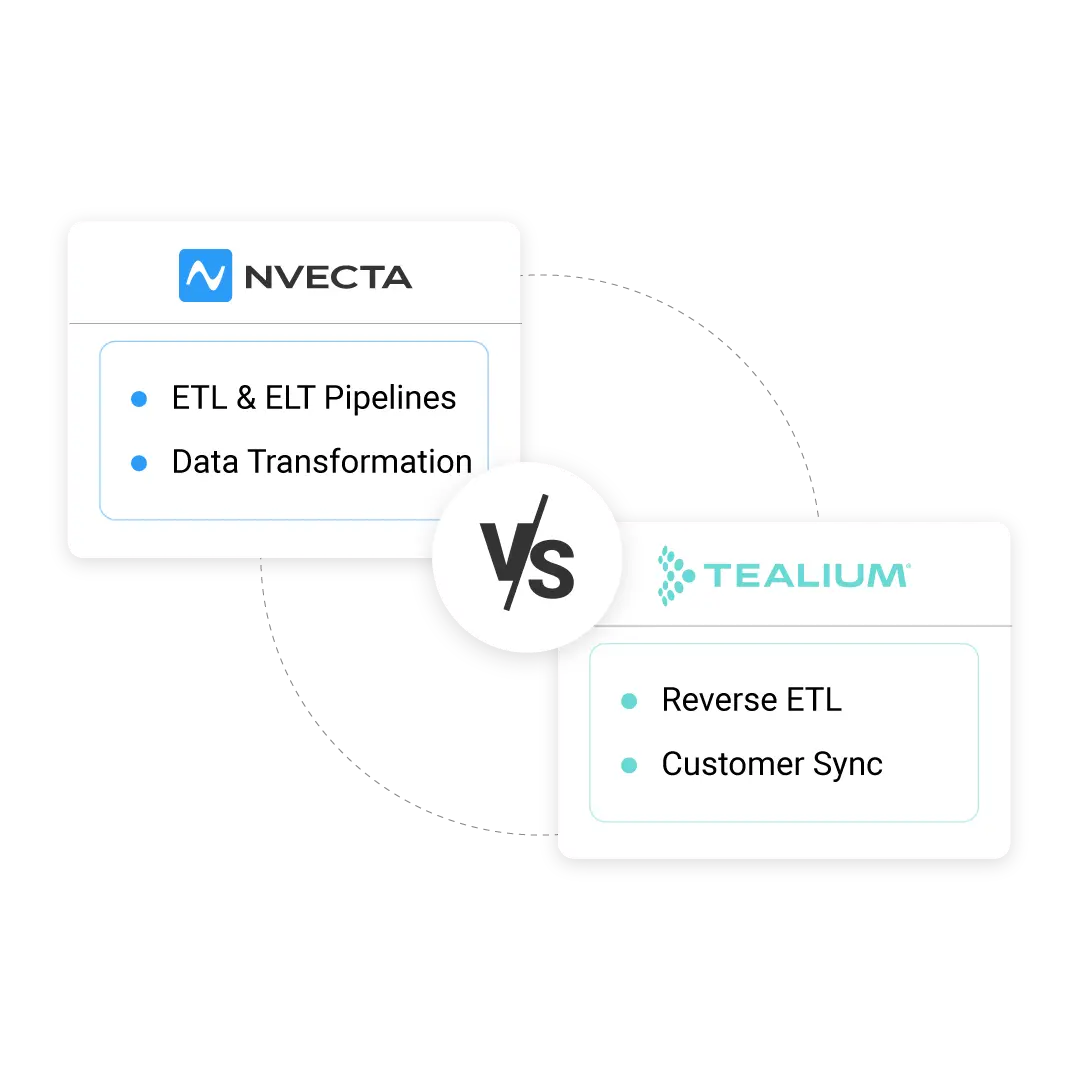
Tealium is a traditional enterprise CDP — built around tag management, data collection, and audience syndication. NVECTA is an AI-native CDP designed for enterprises that need real-time identity resolution, autonomous next-best-action, and AI decisioning that Tealium's rules-based architecture was never built to deliver.
NVECTA vs Tealium

Trusted by thousands

Success quantified

Real results from real customers—measured across ROI, growth and retention

500+

satisfied clients globally

98%

clients satisfaction

5x

ROI for clients

2x

more conversion

Why Teams Switch to NVECTA

What do you actually get that Tealium can't give you?

Not just features — real outcomes your marketing and data teams will feel from week one.

Tealium runs rules. NVECTA makes decisions.

Tealium's AudienceStream is built around rule-based audience attributes — if this, then that. Your team writes the logic, maintains the logic, and lives with the results of the logic. NVECTA's reinforcement learning engine continuously tests and refines next-best-actions for every customer automatically, without a rulebook. It gets better the longer it runs.

4.2× higher campaign conversion vs rule-based segmentation

Live in 2 weeks — not 6 months.

Tealium implementations are notoriously long. Tag configuration, EventStream setup, AudienceStream rule building, and connector mapping typically take 3–6 months before marketing sees any value. NVECTA's pre-built industry connectors and guided onboarding get your first audiences live in under 2 weeks. No professional services engagement required to get started.

<14 days median time to first live activation

Zero-copy by design — not by configuration.

Tealium stores your customer data on its own infrastructure by default. For banks, insurers, and healthcare companies operating under RBI, DPDP, or HIPAA rules, that requires additional legal agreements and ongoing vendor risk assessments. NVECTA is zero-copy at the architecture level — your data never leaves your cloud, no configuration required.

0 customer data records stored on NVECTA servers — zero-copy is the default, not an option

Case studies

See how our customers achieve success

Should you choose NVECTA over Tealium?

Tealium built a strong business on tag management and rule-based audience activation. For teams that need to go beyond rules — to AI-driven personalisation, sub-second real-time, and a platform that gets faster without more analyst hours — NVECTA is the next step.

Rules don't scale. AI does.

Tealium's AudienceStream requires your team to define, maintain, and update every audience rule manually. At 100 rules that's manageable. At 400 rules across 8M customers it becomes a full-time job. NVECTA's RL engine replaces the rulebook — it learns which actions work and applies them automatically, without a configuration backlog.

6 months to value is too long.

Tealium implementations routinely take 3–6 months before marketing runs a single campaign. That's 3–6 months of professional services fees, internal developer time, and delayed ROI. NVECTA gets your first audiences activated in under 2 weeks with guided onboarding and pre-built connectors. No PS engagement needed to get started.

Your data lives on Tealium's servers.

Tealium stores customer profiles and event history on its own infrastructure by default. For banks, insurers, and healthcare companies operating under RBI data localisation rules or the DPDP Act 2023, that requires additional legal review, DPAs, and ongoing vendor risk assessments. NVECTA is zero-copy — your data never moves from your cloud.

FAQ section

Questions people are actually asking
about NVECTA vs Tealium

Sourced from Google, ChatGPT, Gemini, and Perplexity searches — answered straight.

Most teams don't do a hard cutover. They run NVECTA alongside Tealium initially — connecting to the same data sources and validating outputs in parallel. Tealium's tag management layer can stay in place if you want, since NVECTA ingests event streams natively. What typically changes first is the audience building and activation layer, where teams see the fastest ROI improvement. The full switch usually happens over 3–6 months as teams gain confidence and reduce their Tealium contract scope gradually.

Tealium's base contract is typically a six-figure annual commitment, with DataAccess, Tealium Predict, and extended data retention each billed separately. Most enterprises end up paying for capabilities bundled into packages they don't fully use. NVECTA uses usage-based, modular pricing — you pay for events processed, destinations activated, and compute consumed. Identity resolution, AI decisioning, journey orchestration, and measurement are all included. At equivalent scale, teams switching from Tealium typically see 35–45% cost reduction when comparing full-stack spend.

For most teams, the practical migration takes 4–6 weeks for the core use cases. Week 1–2: connect Nvecta to your existing data sources (warehouse, streaming pipeline, or Tealium's event stream directly). Week 3–4: rebuild your top audience segments in Nvecta's no-code builder — faster than expected because you're not reinventing logic, just moving it. Week 5–6: run both platforms in parallel, validate outputs, and begin activating campaigns via Nvecta. Nvecta provides a dedicated implementation engineer for Tealium migrations at no extra cost. You keep both contracts running until you're confident, then scale down Tealium as you scale up Nvecta.

Tealium Predict is a propensity scoring add-on — it generates purchase likelihood and churn risk scores that you can use in AudienceStream rules. It's useful for adding a predictive signal to a rules-based workflow. It is not an AI decisioning engine. It doesn't automatically test and optimise next-best-actions. It doesn't learn which channel, message, or timing works best for each customer. It gives you a score — what you do with it is still up to your team and your rules. Nvecta's reinforcement learning engine goes several layers deeper: it tests actions in the real world, observes outcomes, and continuously improves activation without human intervention.

Tealium EventStream ingests events quickly — that part is genuinely real-time. The problem is what happens next. Events need to land in EventStream, update the visitor profile in AudienceStream, match a rule condition, and then trigger a connector action. In practice that evaluation cycle takes 1–3 minutes under normal load. Nvecta decouples event processing from profile updates — behavioural events trigger decisions in a separate real-time stream with sub-second latency. For trading alerts, loan application follow-ups, cart abandonment, or fraud flags, the difference between 30 seconds and 3 minutes is whether the intervention works at all.

Tealium's 1300+ connector count is impressive, but the majority are tag-based JavaScript integrations built for web analytics and digital marketing tools — most of them US-centric. Nvecta has 500+ destinations, which covers every major tool in the Tealium catalog that Indian enterprises actually use, plus significantly deeper coverage of Indian martech: WhatsApp Business API, MoEngage, CleverTap, WebEngage, Netcore, Kaleyra, Exotel, all major Indian payment platforms, and the full BFSI tool ecosystem. If a destination isn't in our catalog, our team builds it — typically in under 2 weeks. Connector count is less important than whether the right connectors are maintained and production-ready for your market.

Flexible insurance plans for your
health, home, car, and future.

At NextSaaS, we help individuals and families secure financial protection with smart, personalized insurance coverage—fast, simple, and built around your life.

Customers love us

G2 Badge
G2 Badge
G2 Badge
G2 Badge
G2 Badge
G2 Badge
G2 Badge
Get started

Ready to transform your workflow?

Ready to unify your customer data and deliver personalized experiences?