CDP Comparison 2026

NVECTA vs Segment: Complete Comparison Guide

Segment is a traditional CDP — great at collecting and routing data, but built before AI decisioning mattered. NVECTA is an AI-native CDP designed for enterprises that need real-time intelligence, autonomous next-best-action, and activation across every channel — without Segment's Twilio overhead.
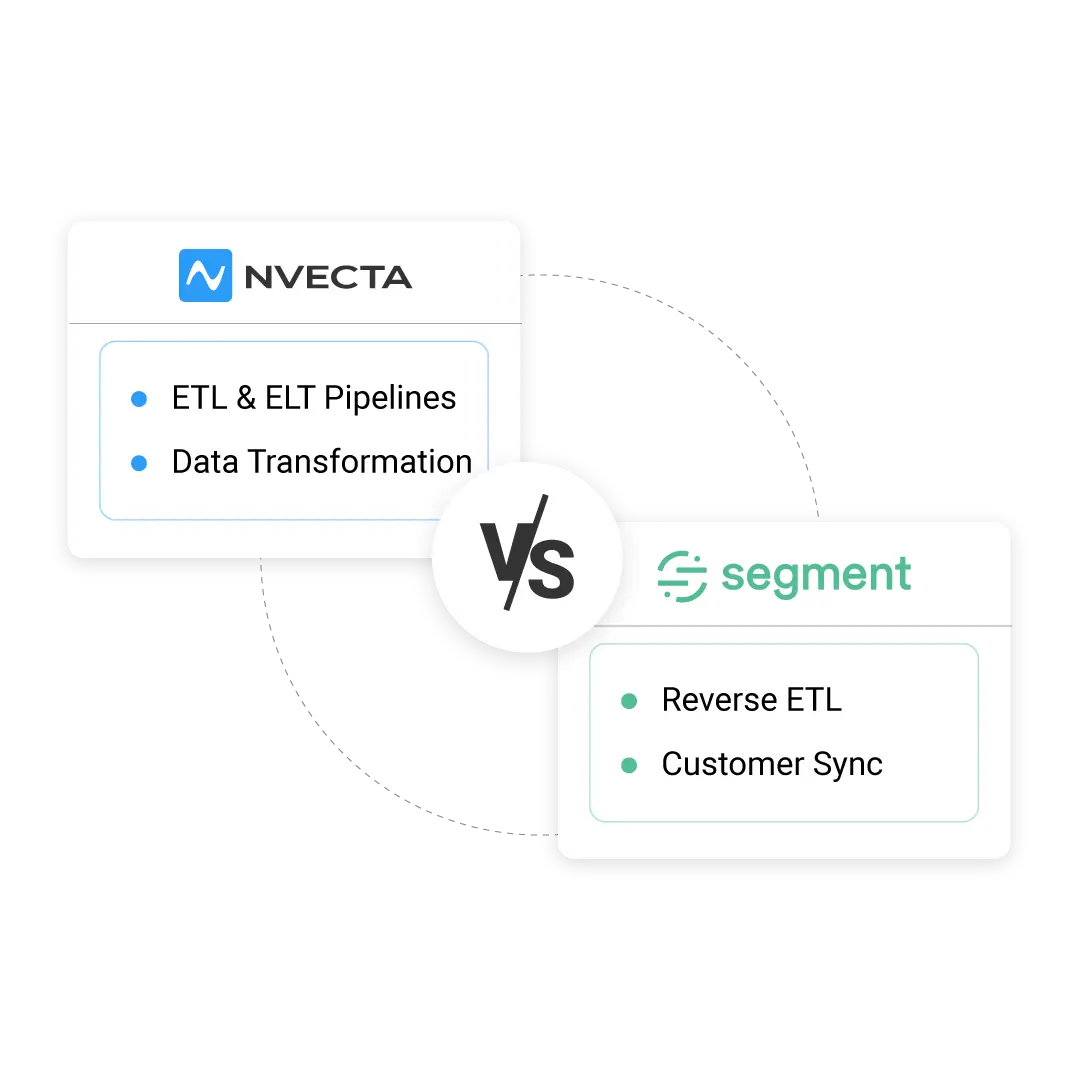
NVECTA vs Segment

Trusted by thousands

Success quantified

Real results from real customers—measured across ROI, growth and retention

500+

satisfied clients globally

98%

clients satisfaction

5x

ROI for clients

2x

more conversion

Why Teams Switch to Nvecta

What do you actually get that Segment can't give you?

Not just features — real outcomes your marketing and data teams will feel from week one.

Segment routes data. NVECTA decides what to do with it.

Segment is a data pipe — it collects events and forwards them to other tools. You still need a separate MA platform, an ML team, and a CRM to actually do anything with it. NVECTA's RL engine turns raw events into autonomous next-best-actions, without three more tools in the chain.

4.2× higher campaign conversion vs rule-based segmentation

No MTU billing. Your costs don't explode as you grow.

Segment charges per Monthly Tracked User. At 5M+ profiles, that bill gets uncomfortable fast — and that's before you add Unify (identity) and engage (journeys) as separate paid products. NVECTA bundles all of it with usage-based pricing and no per-user charge.

38% average cost reduction vs equivalent Segment stack at enterprise scale

One platform. Not five duct-taped together.

A typical Segment deployment ends up paired with a data warehouse, a reverse ETL tool, an ML platform, and a journey orchestration tool. NVECTA replaces the entire stack — collection, identity, AI, journeys, and activation — in a single contract.

4 → 1 average vendor consolidation after switching to NVECTA

Case studies

See how our customers achieve success

Should you choose NVECTA over Segment?

Segment is a solid event collection layer. But collection alone doesn't drive revenue — decisioning does. If your team is still stitching together Segment, Engage, Unify, an ML tool, and a reverse ETL layer, there's a simpler way.

You're paying for three products to do one job

Segment's base plan is just a data pipe. Identity (Unify) and journeys (Engage) cost extra. Most teams end up with three Segment contracts before they can run a personalized campaign. NVECTA does all of it in one.

Segment has no AI — it never will

Segment's job is to collect and route events. AI decisioning isn't on their roadmap in any meaningful way. If you want autonomous next-best-action that improves over time, you need a platform that was built for it from day one — not bolted on.

Your data lives on Twilio's servers

Segment stores customer profiles and event history on its own infrastructure. For banks, insurers, and healthcare companies operating under RBI, DPDP, or HIPAA rules, that's a real compliance problem. NVECTA is zero-copy — your data never moves.

FAQ section

Questions people are actually asking
about NVECTA vs Segment

Sourced from Google, ChatGPT, Gemini, and Perplexity searches — answered straight.

No. Most teams keep their Segment instrumentation in place and point it at Nvecta as a destination. Your SDK calls don't change. Nvecta ingests Segment's event stream natively, so you get Nvecta's AI decisioning layer and identity resolution on top of the events you're already collecting — without re-instrumenting a single line of code. If you eventually want to move fully off Segment, Nvecta's own SDKs are a drop-in replacement, but that's optional, not required.

Segment charges per Monthly Tracked User — so your bill goes up every time you acquire a customer, whether you activate that customer or not. Nvecta doesn't bill by MTU. Pricing is based on usage: events processed, destinations activated, and compute consumed. At the 5M+ profile level, most teams find Nvecta costs 30–40% less than the equivalent Segment stack (Connections + Unify + Engage). You also stop paying for three separate add-ons — identity, journeys, and AI are all included in one contract.

For most teams, the practical migration takes 2–3 weeks. Week 1: connect your existing Segment stream (or warehouse) to Nvecta and validate your top audiences. Week 2: rebuild your active journeys using Nvecta's no-code builder — this is usually faster than expected because you're not re-defining logic, just moving it. Week 3: run both platforms in parallel, compare outputs, then cut over. Nvecta assigns a dedicated implementation engineer at no extra cost for Segment migrations. You keep your existing contracts running until you're confident.

No, this is one of the biggest architectural differences. Segment ingests and stores your event data and customer profiles on Twilio/Segment's infrastructure. For banks, insurance companies, and healthcare organizations under RBI, DPDP Act 2023, or HIPAA, that creates a genuine compliance problem. Nvecta is a zero-copy platform. Your data stays in your own cloud environment (AWS, Azure, or GCP). Nvecta reads and processes it there, then pushes activation outputs to your destinations — nothing is copied to our servers. This is why regulated enterprises choose us over Segment.

Segment's job is to collect and route data — it doesn't try to decide what to do with it. Nvecta's AI decisioning engine runs on top of your event stream and customer profiles. It uses reinforcement learning to continuously test and refine next-best-actions for each customer — channel, timing, message, offer — without you needing to define rules manually or maintain a separate ML pipeline. For propensity scoring (churn, upsell, purchase likelihood), Nvecta's built-in models are production-ready out of the box using your historical data. If you already have custom models, Nvecta can consume their outputs and layer activation on top.

Segment does support streaming event ingestion — events arrive quickly. The problem is what happens after. To trigger a journey or update an audience segment, Segment's Engage product needs the event to land, be processed, update the profile, and match a journey entry condition. In practice that takes 1–5 minutes depending on your plan and traffic volume. Nvecta processes behavioural events in a separate real-time stream that bypasses the profile update cycle, enabling sub-second audience qualification. For use cases like trade alerts, fraud triggers, cart abandonment, or loan application follow-ups, the difference between 30 seconds and 5 minutes is the entire business case.

Nvecta has 500+ destinations vs Segment's 450+, so the raw catalog is comparable. The meaningful difference is depth, not breadth. Nvecta was built for the Indian enterprise market — so you get native, maintained connectors for WhatsApp Business API, Salesforce, HubSpot, MoEngage, CleverTap, WebEngage, Netcore, Kaleyra, all major Indian payment and lending platforms, and the full set of BFSI tools. Segment's connector list is US-centric; many Indian martech integrations are community-maintained and less reliable. If you have a tool that's not in our catalog, our team builds custom connectors — typically in under 2 weeks.

Your customer data, protected by design

Trusted by teams worldwide

NVECTA is built with enterprise-grade security to protect customer data at every layer. From secure data ingestion and role-based access controls to encryption in transit and at rest, your data stays protected at all times.

gdpr
iso
gdpr

Customers love us

G2 Badge
G2 Badge
G2 Badge
G2 Badge
G2 Badge
G2 Badge
G2 Badge
Still using Segment?

See how NVECTA replaces it — in a free 30-min walkthrough

No prep needed. Bring your current stack and we'll show you the delta.

Still Evaluating CDPs? Compare More Options