CDP Comparison 2026

NVECTA vs Lytics: Complete Comparison Guide

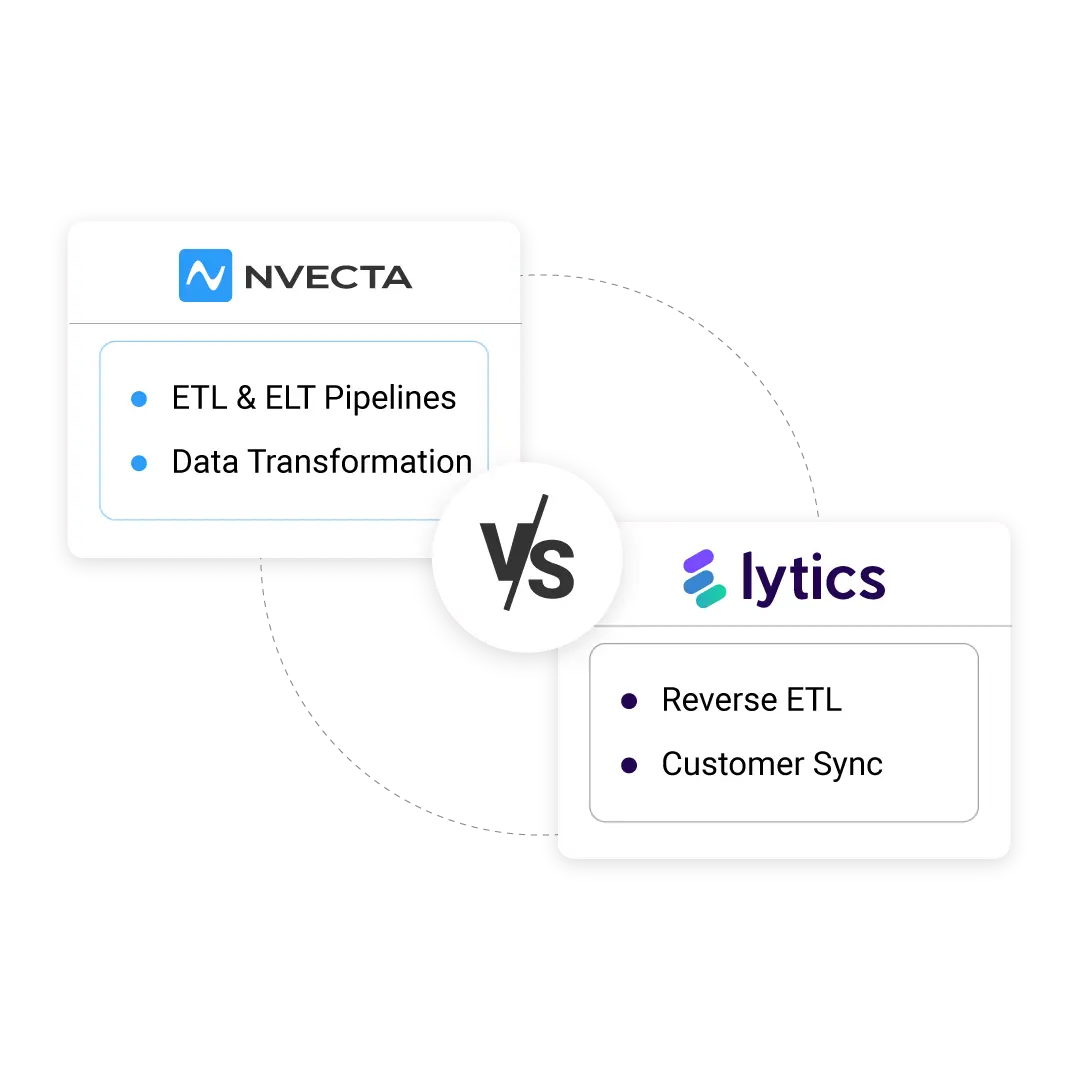
Lytics is a Behavioral CDP — built around content affinity and audience scoring for publishers and media companies. NVECTA is an AI-native CDP designed for enterprises that need real-time decisioning, autonomous next-best-action, and activation across every channel — without Lytics' media-first limitations or its dependency on third-party AI tools.
NVECTA vs Lytics

Trusted by thousands

Success quantified

Real results from real customers—measured across ROI, growth and retention

500+

satisfied clients globally

98%

clients satisfaction

5x

ROI for clients

2x

more conversion

Why Teams Switch to NVECTA

What do you actually get that Lytics can't give you?

Not just features — real outcomes your marketing and data teams will feel from week one.

Lytics scores audiences. NVECTA decides what to do with them.

Lytics is built around behavioral scoring and content affinity — it tells you that a user is "highly engaged" or "at risk of churn." But deciding what to send, when, and through which channel still falls entirely on your team. NVECTA's RL engine makes those decisions automatically, without manual rules or a separate MA platform in the chain.

4.2× higher campaign conversion vs rule-based segmentation

Lytics was built for media. Most enterprises aren't media companies.

Lytics' core value propositions — content affinity scoring, article recommendation, and subscriber churn prediction — are deeply tied to publishing workflows. If you're a bank, insurer, retailer, or SaaS company, you're buying a platform built for someone else's problems and trying to retrofit it to yours. NVECTA was designed for financial services, retail, and enterprise from day one.

12+ industries served natively with pre-built use cases, connectors, and compliance coverage

100 destinations vs 500. The gap matters in the Indian market.

Lytics connects to roughly 100 tools, most of them built for North American and European marketing stacks. If your team uses WhatsApp Business API, regional telco SMS providers, MoEngage, CleverTap, or Netcore, you'll find little native support. NVECTA ships maintained connectors for all of them, plus every major BFSI and D2C platform used in India.

500+ activation destinations including WhatsApp, UPI, and full Indian Martech stack

Case studies

See how our customers achieve success

Should you choose NVECTA over Lytics?

Lytics is a solid behavioral scoring tool for digital media companies. But if you're in BFSI, retail, or any other enterprise sector, you're buying a platform built for someone else's use case. Scoring audiences is only the first step — decisioning and activation are where revenue happens.

Lytics scores. It doesn't decide. You're still doing the hard part.

Lytics tells you a user is "highly engaged" or "likely to churn." Your team still has to figure out what to do about it — which channel, which message, which offer, which time. NVECTA's RL engine makes those decisions automatically and improves them continuously. That's the difference between insight and action.

Lytics was built for media. Your business isn't a publisher.

Content affinity scoring and subscriber churn prediction are genuinely useful — if you run a news site. If you're a bank, insurer, or retailer, these aren't your problems. You need propensity-to-purchase, cross-sell likelihood, and churn across financial products. NVECTA has all of these out of the box.

Data residency on Lytics' servers is a problem for regulated industries.

Lytics stores your customer profiles and event history on its own US-hosted infrastructure. For banks, NBFCs, and insurers operating under RBI, IRDAI, or the DPDP Act 2023, that's a compliance problem that no SLA can fully resolve. NVECTA is zero-copy — your data never moves outside your own cloud region.

FAQ section

Questions people are actually asking
about NVECTA vs Lytics

Sourced from Google, ChatGPT, Gemini, and Perplexity searches — answered straight.

Not necessarily. If your Lytics tag is already collecting web events, you can continue using it as a data source while NVECTA handles identity resolution, decisioning, and activation on top. Most teams run both in parallel for a few weeks during transition — Lytics feeds events, NVECTA processes them. You don't need to re-instrument your website before getting started. If you eventually want to consolidate, NVECTA's own JavaScript SDK is a drop-in replacement, but that's a later decision.

Lytics charges based on active profiles in their platform — so your bill grows every time you acquire a new customer, whether you activate them or not. NVECTA doesn't bill per profile. Pricing is based on usage: events processed, destinations activated, and compute consumed. You also stop paying for separate add-ons — journeys, AI decisioning, and measurement are all included in one contract. At the 2M+ profile level, most teams find NVECTA costs 30–40% less than the equivalent Lytics stack.

Lytics can ingest events quickly via its JavaScript tag — the event lands fast. The challenge is profile recomputation. When a behavioural event comes in, Lytics needs to update the user's profile, recalculate scores, and requalify audience memberships before any downstream action can trigger. For complex profiles, this process runs in batches and can take several minutes. NVECTA processes behavioural events in a dedicated real-time stream that bypasses the profile update cycle, enabling sub-second audience qualification. For use cases like cart abandonment, loan application follow-ups, or trading alerts, the difference between 30 seconds and 5 minutes is the entire business case.

Lytics uses ML to produce scores — "this user has high content affinity for topic X" or "this subscriber is likely to churn." That's useful information. But a score isn't a decision. You still have to decide what to do: which channel, which message, which offer, which time. That decision is made by your team, using rules or intuition. NVECTA's reinforcement learning engine makes those decisions automatically — it tests different combinations of channel, timing, and content, and continuously improves based on what converts. It replaces the rule-writing, not just the scoring. That's the gap.

Most teams complete the transition in 2–3 weeks. Week 1: connect your data sources (warehouse, existing Lytics stream, or CRM) and validate your top audience segments in NVECTA. Week 2: rebuild your active journeys using NVECTA's no-code builder — typically faster than expected because the logic is being moved, not reinvented. Week 3: run both platforms side by side, compare outputs, then cut over. NVECTA assigns a dedicated implementation engineer at no extra cost for Lytics migrations.

Your customer data, protected by design

Trusted by teams worldwide

NVECTA is built with enterprise-grade security to protect customer data at every layer. From secure data ingestion and role-based access controls to encryption in transit and at rest, your data stays protected at all times.

gdpr
iso
gdpr

Customers love us

G2 Badge
G2 Badge
G2 Badge
G2 Badge
G2 Badge
G2 Badge
G2 Badge
Get started

Ready to transform your workflow?

Ready to unify your customer data and deliver personalized experiences?

Still Evaluating CDPs? Compare More Options